Ideal Mass
 .
.![\includegraphics[scale=0.9]{eps/lmass}](http://www.dsprelated.com/josimages_new/pasp/img1575.png)
The concept of impedance extends also to masses and springs.
Figure 7.2 illustrates an ideal mass of  kilograms
sliding on a frictionless surface. From Newton's second law of motion, we
know force equals mass times acceleration, or
kilograms
sliding on a frictionless surface. From Newton's second law of motion, we
know force equals mass times acceleration, or

Since impedance is defined in terms of force and velocity, we will prefer the
form
 . By the differentiation theorem for Laplace transforms
[284],8.1we have
. By the differentiation theorem for Laplace transforms
[284],8.1we have
![$\displaystyle F(s) = m [s V(s) - v(0)].
$](http://www.dsprelated.com/josimages_new/pasp/img1578.png)
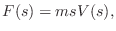
 of the mass in the frequency domain is simply
 is therefore
 ) to produce the output
velocity. This is just a ``linear systems'' way of saying force equals
mass times acceleration.
) to produce the output
velocity. This is just a ``linear systems'' way of saying force equals
mass times acceleration.
Since we normally think of an applied force as an input and the resulting
velocity as an output, the corresponding transfer function is
 . The system diagram for this view
is shown in Fig. 7.3.
. The system diagram for this view
is shown in Fig. 7.3.
The impulse response of a mass, for a force input and velocity output, is defined as the inverse Laplace transform of the transfer function:
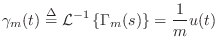
 corresponds to
transferring a unit momentum to the mass at time 0. (Recall that
momentum is the integral of force with respect to time.) Since momentum is
also equal to mass times its velocity
corresponds to
transferring a unit momentum to the mass at time 0. (Recall that
momentum is the integral of force with respect to time.) Since momentum is
also equal to mass times its velocity  , it is clear that the
unit-momentum velocity must be
, it is clear that the
unit-momentum velocity must be  .
.
![\includegraphics[scale=0.9]{eps/lblackbox}](http://www.dsprelated.com/josimages_new/pasp/img1587.png) |
 as the input, velocity
  as
the output, and admittance
as
the output, and admittance  as the transfer function.
Once the input and output signal are defined, a transfer function is
defined, and therefore a frequency response is defined [485].
The frequency response is given by the transfer function evaluated on
the  axis in the
  plane, i.e., for
  . For the ideal mass,
the force-to-velocity frequency response is
. For the ideal mass,
the force-to-velocity frequency response is
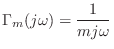
 dB per octave, and the phase
shift is
dB per octave, and the phase
shift is  radians at all frequencies.
In circuit theory, the element analogous to the mass is the inductor,
characterized by
 , or
, or
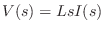 . In an analog
equivalent circuit, a mass can be represented using an inductor with value
. In an analog
equivalent circuit, a mass can be represented using an inductor with value
 .
.
Next Section:
Ideal Spring
Previous Section:
Dashpot