Ideal Spring
Figure 7.4 depicts the ideal spring.
 .
.![\includegraphics[width=3in]{eps/lspring}](http://www.dsprelated.com/josimages_new/pasp/img1592.png)
From Hooke's law, we have that the applied force is proportional to the displacement of the spring:
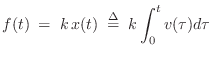
 .
The spring constant
.
The spring constant  is sometimes called the stiffness of the
spring. Taking the Laplace transform gives
is sometimes called the stiffness of the
spring. Taking the Laplace transform gives
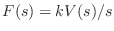

 ) to
produce the output velocity.
) to
produce the output velocity.
The frequency response of the ideal spring, given the applied force as input and resulting velocity as output, is
In this case, the amplitude response grows
 dB per octave, and the phase
shift is
dB per octave, and the phase
shift is  radians for all
  . Clearly, there is no such thing as
an ideal spring which can produce arbitrarily large gain as frequency goes
to infinity; there is always some mass in a real spring.
. Clearly, there is no such thing as
an ideal spring which can produce arbitrarily large gain as frequency goes
to infinity; there is always some mass in a real spring.
We call  the compression velocity of the spring. In more
complicated configurations, the compression velocity is defined as the
difference between the velocity of the two spring endpoints, with positive
velocity corresponding to spring compression.
the compression velocity of the spring. In more
complicated configurations, the compression velocity is defined as the
difference between the velocity of the two spring endpoints, with positive
velocity corresponding to spring compression.
In circuit theory, the element analogous to the spring is the capacitor,
characterized by
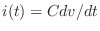 , or
, or
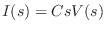 .
In an equivalent analog circuit, we can use the value
.
In an equivalent analog circuit, we can use the value  . The
inverse
. The
inverse  of the spring stiffness is sometimes called the
compliance
of the spring.
of the spring stiffness is sometimes called the
compliance
of the spring.
Don't forget that the definition of impedance requires zero initial conditions for elements with ``memory'' (masses and springs). This means we can only use impedance descriptions for steady state analysis. For a complete analysis of a particular system, including the transient response, we must go back to full scale Laplace transform analysis.
Next Section:
Series Combination of One-Ports
Previous Section:
Ideal Mass