







Impedance Networks
The concept of impedance is central in classical electrical
engineering. The simplest case is Ohm's Law for a resistor
 :
:
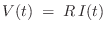
 denotes the voltage across the resistor at time
  , and
, and
 is the current through the resistor. For the corresponding mechanical
element, the dashpot, Ohm's law becomes
is the current through the resistor. For the corresponding mechanical
element, the dashpot, Ohm's law becomes
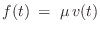
 is the force across the dashpot at time , and
  is its compression velocity. The dashpot value
  is thus a
mechanical resistance.2.14
is thus a
mechanical resistance.2.14
Thanks to the Laplace transform [449]2.15(or Fourier transform [451]),
the concept of impedance easily extends to masses and springs as well.
We need only allow impedances to be frequency-dependent. For
example, the Laplace transform of Newton's  yields, using the
differentiation theorem for Laplace transforms [449],
yields, using the
differentiation theorem for Laplace transforms [449],

 denotes the Laplace transform of (``
 ''), and similarly for displacement, velocity, and
acceleration Laplace transforms. (It is assumed that all initial
conditions are zero, i.e.,
''), and similarly for displacement, velocity, and
acceleration Laplace transforms. (It is assumed that all initial
conditions are zero, i.e.,
 .)
The mass impedance is therefore
.)
The mass impedance is therefore
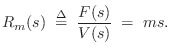
 gives
gives
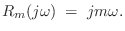
 is given by
![\begin{eqnarray*}
R_k(s) &=& \frac{k}{s}\\ [5pt]
R_k(j\omega) &=& \frac{k}{j\omega}.
\end{eqnarray*}](http://www.dsprelated.com/josimages_new/pasp/img362.png)
The important benefit of this frequency-domain formulation of impedance is that it allows every interconnection of masses, springs, and dashpots (every RLC equivalent circuit) to be treated as a simple resistor network, parametrized by frequency.
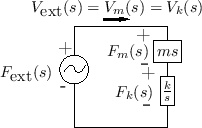 |
As an example, Fig.1.11 gives the impedance diagram corresponding to the equivalent circuit in Fig.1.10. Viewing the circuit as a (frequency-dependent) resistor network, it is easy to write down, say, the Laplace transform of the force across the spring using the voltage divider formula:

Next Section:
Wave Digital Filters
Previous Section:
Equivalent Circuits












