Impulse Response of State Space Models
As derived in Book II [449, Appendix G], the impulse response of the state-space model can be summarized as
![$\displaystyle {\mathbf{h}}(n) \eqsp \left\{\begin{array}{ll} D, & n=0 \\ [5pt] CA^{n-1}B, & n>0 \\ \end{array} \right. \protect$](http://www.dsprelated.com/josimages_new/pasp/img268.png)
Thus, the
 th ``sample'' of the impulse response is given by
 for
for  . Each such ``sample'' is a
  matrix, in
general.
matrix, in
general.
In our force-driven-mass example, we have  ,
,
![$ B=[0,T/m]^T$](http://www.dsprelated.com/josimages_new/pasp/img273.png) , and
, and
 . For a position output we have
 ![$ C=[1,0]$](http://www.dsprelated.com/josimages_new/pasp/img275.png) while for a velocity
output we would set
while for a velocity
output we would set ![$ C=[0,1]$](http://www.dsprelated.com/josimages_new/pasp/img276.png) . Choosing
. Choosing
 simply feeds
the whole state vector to the output, which allows us to look at both
simultaneously:
simply feeds
the whole state vector to the output, which allows us to look at both
simultaneously:
![\begin{eqnarray*}
{\mathbf{h}}(n+1) &=&\left[\begin{array}{cc} 1 & 0 \\ [2pt] 0 ...
...\left[\begin{array}{c} nT \\ [2pt] 1 \end{array}\right]
\protect
\end{eqnarray*}](http://www.dsprelated.com/josimages_new/pasp/img278.png)
Thus, when the input force is a unit pulse, which corresponds
physically to imparting momentum  at time 0 (because the
time-integral of force is momentum and the physical area under a unit
sample is the sampling interval ), we see that the velocity after
time 0 is a constant
at time 0 (because the
time-integral of force is momentum and the physical area under a unit
sample is the sampling interval ), we see that the velocity after
time 0 is a constant  , or
, or  , as expected from
conservation of momentum. If the velocity is constant, then the
position must grow linearly, as we see that it does:
, as expected from
conservation of momentum. If the velocity is constant, then the
position must grow linearly, as we see that it does:
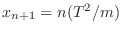 . The finite difference approximation to the time-derivative
of
. The finite difference approximation to the time-derivative
of  now gives
 , for
, for  , which
is consistent.
, which
is consistent.
Next Section:
Zero-Input Response of State Space Models
Previous Section:
State Definition