Input Locality
The DW state-space model is given in terms of the FDTD state-space
model by Eq. (E.31). The similarity transformation matrix
 is
bidiagonal, so that
is
bidiagonal, so that
 and
and
 are both approximately
diagonal when the output is string displacement for all
are both approximately
diagonal when the output is string displacement for all  . However,
since
. However,
since
 given in Eq.(E.11) is upper triangular, the input matrix
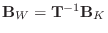 can replace sparse input matrices
 with only
half-sparse
with only
half-sparse
 , unless successive columns of
are equally
weighted, as discussed in §E.3. We can say that local
K-variable excitations may correspond to non-local W-variable
excitations. From Eq.(E.35) and Eq.(E.36), we see that
displacement inputs are always local in both systems.
Therefore, local FDTD and non-local DW excitations can only occur when
a variable dual to displacement is being excited, such as velocity.
If the external integrator Eq.(E.37) is used, all inputs are
ultimately displacement inputs, and the distinction disappears.
, unless successive columns of
are equally
weighted, as discussed in §E.3. We can say that local
K-variable excitations may correspond to non-local W-variable
excitations. From Eq.(E.35) and Eq.(E.36), we see that
displacement inputs are always local in both systems.
Therefore, local FDTD and non-local DW excitations can only occur when
a variable dual to displacement is being excited, such as velocity.
If the external integrator Eq.(E.37) is used, all inputs are
ultimately displacement inputs, and the distinction disappears.
Next Section:
Resistive Terminations
Previous Section:
DW Non-Displacement Inputs