Kinetic Energy of a Mass
Kinetic energy is energy associated with motion. For example, when a spring uncompresses and accelerates a mass, as in the configuration of Fig.B.2, work is performed on the mass by the spring, and we say that the potential energy of the spring is converted to kinetic energy of the mass.
Suppose in Fig.B.2 we have an initial spring compression
by  meters at time
  , and the mass velocity is zero at
. Then from the equation of motion Eq.
, and the mass velocity is zero at
. Then from the equation of motion Eq. (B.5), we can calculate
when the spring returns to rest (
(B.5), we can calculate
when the spring returns to rest ( ). This first happens at the
first zero of
). This first happens at the
first zero of
 , which is time
 . At this time, the velocity,
given by the time-derivative of Eq.(B.5),
. At this time, the velocity,
given by the time-derivative of Eq.(B.5),
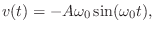
 to yield the mass velocity
![$ v[(\pi/2)/\omega_0] = -A\omega_0 = -A\sqrt{k/m}$](http://www.dsprelated.com/josimages_new/pasp/img2652.png) , which is when all
potential energy from the spring has been converted to kinetic energy
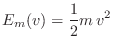
in the mass. The square of this value is
, which is when all
potential energy from the spring has been converted to kinetic energy
in the mass. The square of this value is
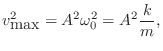
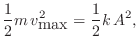
 by
by  , we get
Next Section:
Mass Kinetic Energy from Virtual Work
Previous Section:
Potential Energy in a Spring