Localized Velocity Excitations
Initial velocity excitations are straightforward in the DW paradigm,
but can be less intuitive in the FDTD domain. It is well known that
velocity in a displacement-wave DW simulation is determined by the
difference of the right- and left-going waves
[437]. Specifically, initial velocity waves  can
be computed from from initial displacement waves
can
be computed from from initial displacement waves  by spatially
differentiating to obtain traveling slope waves
by spatially
differentiating to obtain traveling slope waves
 , multiplying by minus the tension
  to obtain force
waves, and finally dividing by the wave impedance
to obtain force
waves, and finally dividing by the wave impedance
 to
obtain velocity waves:
to
obtain velocity waves:


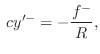
where
 denotes sound speed. The initial string
velocity at each point is then
denotes sound speed. The initial string
velocity at each point is then
 . (A
more direct derivation can be based on differentiating Eq.
. (A
more direct derivation can be based on differentiating Eq. (E.4)
with respect to
(E.4)
with respect to  and solving for velocity traveling-wave
components, considering left- and right-going cases separately at
first, and arguing the general case by superposition.)
and solving for velocity traveling-wave
components, considering left- and right-going cases separately at
first, and arguing the general case by superposition.)
We can see from Eq.(E.11) that such asymmetry can be caused by
unequal weighting of  and
and
 . For example, the
initialization
. For example, the
initialization
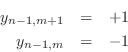
corresponds to an impulse velocity excitation at position
 . In this case, both interleaved grids are excited.
Next Section:
More General Velocity Excitations
Previous Section:
Localized Displacement Excitations