







Mass Moment of Inertia
The mass moment of inertia  (or simply moment of
inertia), plays the role of mass in rotational dynamics, as
we saw in
Eq.
(or simply moment of
inertia), plays the role of mass in rotational dynamics, as
we saw in
Eq. (B.7) above.
The mass moment of inertia of a rigid body, relative to a given axis of rotation, is given by a weighted sum over its mass, with each mass-point weighted by the square of its distance from the rotation axis. Compare this with the center of mass (§B.4.1) in which each mass-point is weighted by its vector location in space (and divided by the total mass).
Equation (B.8) above gives the moment of inertia for a single point-mass
 rotating a distance
  from the axis to be
  . Therefore,
for a rigid collection of point-masses
. Therefore,
for a rigid collection of point-masses  ,
,
 ,B.14 the
moment of inertia about a given axis of rotation is obtained by adding
the component moments of inertia:
,B.14 the
moment of inertia about a given axis of rotation is obtained by adding
the component moments of inertia:

where
 is the distance from the axis of rotation to the
  th
mass.
th
mass.
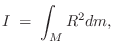
For a continuous mass distribution, the moment of inertia is given by integrating the contribution of each differential mass element:
 |
(B.10) |
where
is the distance from the axis of rotation to the mass
element  .
In terms of the density
.
In terms of the density
 of a continuous mass
distribution, we can write
of a continuous mass
distribution, we can write
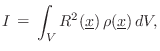 denotes the mass density (kg/m
 ) at the
point
) at the
point
 , and
, and
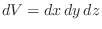 denotes a differential volume element
located at
denotes a differential volume element
located at
 .
.
Circular Disk Rotating in Its Own Plane
For example, the moment of inertia for a uniform circular disk of
total mass  and radius , rotating in its own plane about a
rotation axis piercing its center, is given by
and radius , rotating in its own plane about a
rotation axis piercing its center, is given by

Circular Disk Rotating About Its Diameter
The moment of inertia for the same circular disk rotating about an axis in the plane of the disk, passing through its center, is given by
![$\displaystyle I = \frac{M}{\pi R^2}\cdot 4\int_0^{\pi/2} \int_0^R [r\cos(\theta)]^2\, r\,dr\,d\theta
= \frac{1}{4}MR^2
$](http://www.dsprelated.com/josimages_new/pasp/img2728.png)
Next Section:
Perpendicular Axis Theorem
Previous Section:
Rotational Kinetic Energy












