Mass Moment of Inertia Tensor
As derived in the previous section, the moment of inertia
tensor, in 3D Cartesian coordinates, is a three-by-three matrix
 that can be multiplied by any angular-velocity vector to
produce the corresponding angular momentum vector for either a point
mass or a rigid mass distribution. Note that the origin of the
angular-velocity vector
that can be multiplied by any angular-velocity vector to
produce the corresponding angular momentum vector for either a point
mass or a rigid mass distribution. Note that the origin of the
angular-velocity vector
 is always fixed at
 in the space
(typically located at the center of mass). Therefore, the moment of
inertia tensor
is defined relative to that origin.
in the space
(typically located at the center of mass). Therefore, the moment of
inertia tensor
is defined relative to that origin.
The moment of inertia tensor can similarly be used to compute the
mass moment of inertia for any normalized angular velocity
vector
 as
as

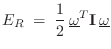
Since rotational energy is defined as
 (see
Eq.
(see
Eq. (B.7)), multiplying Eq.(B.22) by
  gives the following
expression for the rotational kinetic energy in terms of the moment of
inertia tensor:
gives the following
expression for the rotational kinetic energy in terms of the moment of
inertia tensor:
We can show Eq.
(B.22) starting from Eq.(B.14). For a
point-mass  located at
 , we have
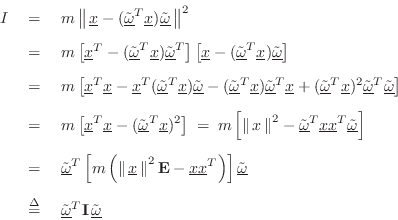
where again
 denotes the three-by-three identity matrix, and
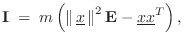
which agrees with Eq.
(B.20). Thus we have derived the moment of
inertia  in terms of the moment of inertia tensor
and the
normalized angular velocity
in terms of the moment of inertia tensor
and the
normalized angular velocity
 for a point-mass at
.
for a point-mass at
.
For a collection of  masses
  located at
 , we
simply sum over their masses to add up the moments of inertia:
, we
simply sum over their masses to add up the moments of inertia:
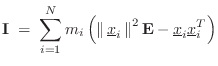

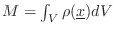 is the total mass.
Simple Example
Consider a mass at
![$ \underline{x}=[x,0,0]^T$](http://www.dsprelated.com/josimages_new/pasp/img2890.png) . Then the mass moment of inertia
tensor is
. Then the mass moment of inertia
tensor is
![$\displaystyle \mathbf{I}\eqsp m \left(\left\Vert\,\underline{x}\,\right\Vert^2\...
...ay}{ccc}
0 & 0 & 0\\ [2pt]
0 & 1 & 0\\ [2pt]
0 & 0 & 1
\end{array}\right].
$](http://www.dsprelated.com/josimages_new/pasp/img2891.png)
![$ \underline{\omega}=[\omega,0,0]^T$](http://www.dsprelated.com/josimages_new/pasp/img2892.png) , we obtain the moment of
inertia
, we obtain the moment of
inertia
![\begin{displaymath}
I \eqsp \underline{\tilde{\omega}}^T\mathbf{I}\,\underline{\...
...{array}{c} 1 \\ [2pt] 0 \\ [2pt] 0\end{array}\right]m \eqsp 0.
\end{displaymath}](http://www.dsprelated.com/josimages_new/pasp/img2893.png)
![$ \underline{\omega}=[0,1,0]^T$](http://www.dsprelated.com/josimages_new/pasp/img2894.png) , we get
, we get
![$\displaystyle I \eqsp \underline{\tilde{\omega}}^T\mathbf{I}\,\underline{\tilde...
...]
\left[\begin{array}{c} 0 \\ [2pt] 1 \\ [2pt] 0\end{array}\right] \eqsp m x^2
$](http://www.dsprelated.com/josimages_new/pasp/img2895.png)
Example with Coupled Rotations
Now let the mass be located at
![$ \underline{x}=[1,1,0]^T$](http://www.dsprelated.com/josimages_new/pasp/img2896.png) so that
so that
![\begin{eqnarray*}
\mathbf{I}&=& m \left(\left\Vert\,\underline{x}\,\right\Vert^2...
... & 0\\ [2pt]
-1 & 1 & 0\\ [2pt]
0 & 0 & 2
\end{array}\right].
\end{eqnarray*}](http://www.dsprelated.com/josimages_new/pasp/img2897.png)
We expect
![$ \underline{\omega}=[1,1,0]$](http://www.dsprelated.com/josimages_new/pasp/img2898.png) to yield zero for the moment of inertia, and
sure enough
to yield zero for the moment of inertia, and
sure enough
 . Similarly, the vector angular
momentum is zero, since
. Similarly, the vector angular
momentum is zero, since
 .
.
For
![$ \underline{\omega}=[1,0,0]^T$](http://www.dsprelated.com/josimages_new/pasp/img2901.png) , the result is
, the result is
![\begin{displaymath}
\mathbf{I}\eqsp
\begin{array}{r}\left[\begin{array}{ccc} 1 ...
...egin{array}{c} 1 \\ [2pt] 0 \\ [2pt] 0\end{array}\right]m = m,
\end{displaymath}](http://www.dsprelated.com/josimages_new/pasp/img2902.png)
 to
is one. The same result is obtained for rotation about
to
is one. The same result is obtained for rotation about
 .
For
.
For
 , however, the result is
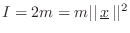 , as
expect.
, as
expect.
Off-Diagonal Terms in Moment of Inertia Tensor
This all makes sense, but what about those  off-diagonal terms in
? Consider the vector angular momentum (§B.4.14):
off-diagonal terms in
? Consider the vector angular momentum (§B.4.14):
![$\displaystyle \underline{L}\eqsp \mathbf{I}\,\underline{\omega}\eqsp
m\left[\b...
...begin{array}{c} \omega_1 \\ [2pt] \omega_2 \\ [2pt] \omega_3\end{array}\right]
$](http://www.dsprelated.com/josimages_new/pasp/img2907.png)
 correspond to a
coupling of rotation about
correspond to a
coupling of rotation about
 with rotation about
 .
That is, there is a component of moment-of-inertia that is
contributed (or subtracted, as we saw above for
.
That is, there is a component of moment-of-inertia that is
contributed (or subtracted, as we saw above for
![$ \underline{\omega}=[1,1,0]^T$](http://www.dsprelated.com/josimages_new/pasp/img2910.png) ) when both
) when both  and
and
 are nonzero. These cross-terms can be eliminated by
diagonalizing the matrix [449],B.25as discussed further in the next section.
are nonzero. These cross-terms can be eliminated by
diagonalizing the matrix [449],B.25as discussed further in the next section.
Next Section:
Principal Axes of Rotation
Previous Section:
Angular Momentum Vector