Mass-Spring Boundedness in Reality
To approach the limit of
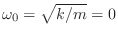 , we must either
take the spring constant
, we must either
take the spring constant  to zero, or the mass
  to infinity, or
both.
to infinity, or
both.
In the case of  , the constant force must approach zero, and we
are left with at most a constant mass velocity in the limit (not a
linearly growing one, since there can be no dc force at the limit).
When the spring force reaches zero,
, the constant force must approach zero, and we
are left with at most a constant mass velocity in the limit (not a
linearly growing one, since there can be no dc force at the limit).
When the spring force reaches zero,  , so that only zeros
will feed into the loop on the right in Fig.F.35, thus avoiding
a linearly growing velocity, as demanded by the physics. (A constant
velocity is free to circulate in the loop on the right, but the loop
on the left must be zeroed out in the limit.)
, so that only zeros
will feed into the loop on the right in Fig.F.35, thus avoiding
a linearly growing velocity, as demanded by the physics. (A constant
velocity is free to circulate in the loop on the right, but the loop
on the left must be zeroed out in the limit.)
In the case of
 , the mass becomes unaffected by the spring
force, so its final velocity must be zero. Otherwise, the attached
spring would keep compressing or stretching forever, and this would
take infinite energy. (Another way to arrive at this conclusion is to
note that the final kinetic energy of the mass would be
, the mass becomes unaffected by the spring
force, so its final velocity must be zero. Otherwise, the attached
spring would keep compressing or stretching forever, and this would
take infinite energy. (Another way to arrive at this conclusion is to
note that the final kinetic energy of the mass would be
 .) Since the total energy in an undriven mass-spring
oscillator is always constant, the infinite-mass limit must be
accompanied by a zero-velocity limit.F.6 This means the mass's
state variable
.) Since the total energy in an undriven mass-spring
oscillator is always constant, the infinite-mass limit must be
accompanied by a zero-velocity limit.F.6 This means the mass's
state variable  in Fig.F.35 must be forced to zero in
the limit so that there will be no linearly growing solution at dc.
in Fig.F.35 must be forced to zero in
the limit so that there will be no linearly growing solution at dc.
In summary, when two or more system poles approach each other to form
a repeated pole, care must be taken to ensure that the limit is
approached in a physically meaningful way. In the case of the
mass-spring oscillator, for example, any change in the spring constant
or mass must be accompanied by the physically appropriate
change in the state variables  and/or . It is
obviously incorrect, for example, to suddenly set
and/or . It is
obviously incorrect, for example, to suddenly set  in the
simulation without simultaneously clearing the spring's state variable
, since the force across an infinitely compliant spring can
only be zero.
in the
simulation without simultaneously clearing the spring's state variable
, since the force across an infinitely compliant spring can
only be zero.
Similar remarks apply to repeated poles corresponding to
 . In this case, the mass and spring basically change
places.
. In this case, the mass and spring basically change
places.
Next Section:
Energy-Preserving Parameter Changes (Mass-Spring Oscillator)
Previous Section:
Physical Perspective on Repeated Poles in the Mass-Spring System