







Mass Termination Model
The previous discussion solved for the motion of an ideal mass striking an ideal string of infinite length. We now investigate the same model from the string's point of view. As before, we will be interested in a digital waveguide (sampled traveling-wave) model of the string, for efficiency's sake (Chapter 6), and we therefore will need to know what the mass ``looks like'' at the end of each string segment. For this we will find that the impedance description (§7.1) is especially convenient.
![\includegraphics[width=\twidth]{eps/massstringphynum}](http://www.dsprelated.com/josimages_new/pasp/img2065.png) |
Let's number the string segments to the left and right of the mass by
1 and 2, respectively, as shown in Fig.9.15. Then
Eq. (9.8) above may be written

where
 denotes the force applied by string-segment 1 to the
mass (defined as positive in the ``up'', or positive-
denotes the force applied by string-segment 1 to the
mass (defined as positive in the ``up'', or positive- direction),
 is the force applied by string-segment 2 to the mass
(again positive upwards), and
is the force applied by string-segment 2 to the mass
(again positive upwards), and  denotes the inertial force applied by
the mass to both string endpoints (where again, a positive force
points up).
denotes the inertial force applied by
the mass to both string endpoints (where again, a positive force
points up).
To derive the traveling-wave relations in a digital waveguide model,
we want to use the force-wave variables
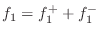 and
and
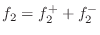 that we defined for vibrating strings in
§6.1.5; i.e., we defined
that we defined for vibrating strings in
§6.1.5; i.e., we defined
 , where
  is the string tension and
  is the string
slope,
is the string
slope,  .
.
![\includegraphics[width=0.5\twidth]{eps/stringslope}](http://www.dsprelated.com/josimages_new/pasp/img2073.png) |
As shown in Fig.9.16, a negative string slope pulls ``up''
to the right. Therefore, at the mass point we have
 , where
  denotes the position of the
mass along the string. On the other hand, the figure also shows that
a negative string slope pulls ``down'' to the left, so that
denotes the position of the
mass along the string. On the other hand, the figure also shows that
a negative string slope pulls ``down'' to the left, so that
 . In summary, relating the forces we
have defined for the mass-string junction to the force-wave variables
in the string, we have
. In summary, relating the forces we
have defined for the mass-string junction to the force-wave variables
in the string, we have
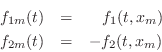
where denotes the position of the mass along the string.
Thus, we can rewrite Eq.(9.11) in terms of string wave variables as

or, substituting the definitions of these forces,

The inertial force of the mass is
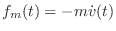 because the mass
must be accelerated downward in order to produce an upward reaction
force. The signs of the two string forces follow from the definition
of force-wave variables on the string, as discussed above.
because the mass
must be accelerated downward in order to produce an upward reaction
force. The signs of the two string forces follow from the definition
of force-wave variables on the string, as discussed above.
The force relations can be checked individually. For string 1,
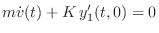
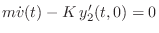
Now that we have expressed the string forces in terms of string
force-wave variables, we can derive digital waveguide models by
performing the traveling-wave decompositions
and
and using the Ohm's law relations
 and
and
 for (introduced above near
Eq.(6.6)).
for (introduced above near
Eq.(6.6)).
Next Section:
Mass Reflectance from Either String
Previous Section:
Matrix Bridge Impedance












