More General Allpass Filters
We have so far seen two types of allpass filters:
- The series combination of feedback and feedforward comb-filters is allpass when their delay lines are the same length and their feedback and feedforward coefficents are the same. An example is shown in Fig.2.30.
- Any delay element in an allpass filter can be replaced by an allpass filter to obtain a new (typically higher order) allpass filter. The special case of nested first-order allpass filters yielded the lattice digital filter structure of Fig.2.32.
Definition:
A linear, time-invariant filter  is said to be
lossless if it preserves signal
energy for every input signal. That is, if the input signal is
is said to be
lossless if it preserves signal
energy for every input signal. That is, if the input signal is
 , and the output signal is
 , we must have
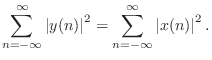
 signal norm
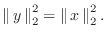
 , this can be
expressed more succinctly as
, this can be
expressed more succinctly as
Notice that only stable filters can be lossless since, otherwise,
 is generally infinite, even when
 is finite. We
further assume all filters are causal3.14 for
simplicity. It is straightforward to show the following:
is finite. We
further assume all filters are causal3.14 for
simplicity. It is straightforward to show the following:
It can be shown [449, Appendix C] that stable, linear,
time-invariant (LTI) filter transfer function is lossless if
and only if

 plane.
Thus, ``lossless'' and ``unity-gain allpass'' are synonymous. For an
allpass filter with gain  at each frequency, the energy gain of the
filter is
at each frequency, the energy gain of the
filter is  for every input signal
  . Since we can describe
such a filter as an allpass times a constant gain, the term
``allpass'' will refer here to the case
. Since we can describe
such a filter as an allpass times a constant gain, the term
``allpass'' will refer here to the case  .
.
Next Section:
Example Allpass Filters
Previous Section:
Nested Allpass Filters