Sign in

username:

password:


Not a member?

Search Online Books


Search tips

Free Online Books


Chapters

See Also

Embedded SystemsFPGAElectronics
Chapter Contents:

Search Physical Audio Signal Processing


Book Index | Global Index


Would you like to be notified by email when Julius Orion Smith III publishes a new entry into his blog?


More General One-Parameter Waves

The wave impedance derivation above made use of known properties of waves in cones to arrive at the wave impedances in the two directions of travel in cones. We now consider how this solution might be generalized to arbitrary bore shapes. The momentum conservation equation is already applicable to any wavefront area variation $ A(x)$:

$\displaystyle p' + p \,$   ln$\displaystyle 'A \eqsp -\rho{\dot u}.
$

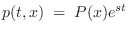
As we did for vibrating stringsC.3.4), suppose the pressure is sinusoidally driven so that we have

$\displaystyle p(t,x) \eqsp P(x) e^{st}
$

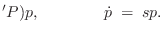
where $ s=j\omega$, $ \omega = 2\pi f$, and $ f$ is the driving frequency. The partial derivatives become

$\displaystyle p' \eqsp ($ln$\displaystyle 'P) p, \qquad \qquad \dot{p}\eqsp s p.
$

Substituting into the momentum equation gives

$\displaystyle p($ln$\displaystyle 'P +$   ln$\displaystyle 'A) \eqsp -\rho {\dot u}.
$

Because the medium is linear and time-invariant, the velocity $ u(t,x)$ must be of the form $ U(x) e^{st}$, and we can define the spatially instantaneous wave impedance as
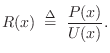
$\displaystyle R(x) \isdefs \frac{P(x)}{U(x)}.
$

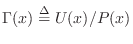
The corresponding instantaneous wave admittance is then $ \Gamma(x)\isdef U(x)/P(x)$. Then $ \u=\Gamma(x) p$, and the momentum equation becomes

   ln$\displaystyle 'P +$   ln$\displaystyle 'A \eqsp -\rho s\Gamma
$

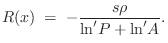
Solving for the wave impedance gives

$\displaystyle R(x) \eqsp -\frac{s\rho}{\mbox{ln}'P + \mbox{ln}'A}.
$

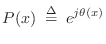
Expressing $ P(x)$ in exponential form as

$\displaystyle P(x) \isdefs e^{j\theta(x)}
$

where $ \theta(x)$ may be complex, we may define the instantaneous spatial frequency (wavenumber) as

$\displaystyle k(x) \isdefs \theta'(x)
$

and since ln$ 'P = j k(x)$, we have

$\displaystyle R(x) \eqsp -\frac{s\rho}{j k(x) + \mbox{ln}'A} \eqsp -\frac{\omega\rho}{k(x) + \mbox{ln}'A}
$

Defining the spatially instantaneous phase velocity as

$\displaystyle c(x)\isdefs \frac{\omega}{k(x)}
$

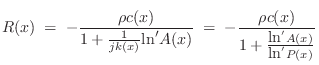
we have

$\displaystyle R(x) \eqsp -\frac{\rho c(x)}{1 + \frac{1}{j k(x)}{\mbox{ln}'A(x)}} \eqsp -\frac{\rho c(x)}{1 + \frac{\mbox{ln}'A(x)}{\mbox{ln}'P(x)}} \protect$ (C.151)

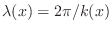
This reduces to the simple case of the uniform waveguide when the logarithmic derivative of cross-sectional area $ A(x)$ is small compared with the logarithmic derivative of the amplitude $ P(x)$ which is proportional to the instantaneous spatial frequency. A traveling wave solution interpretation makes sense when the instantaneous wavenumber $ k(x)$ is approximately real, and the phase velocity $ c(x)$ is approximately constant over a number of wavelengths $ \lambda(x) = 2\pi/k(x)$.

Previous: Wave Impedance in a Cone

Next: Generalized Wave Impedance

Order a Hardcopy of Physical Audio Signal Processing


About the Author: Julius Orion Smith III
Julius Smith's background is in electrical engineering (BS Rice 1975, PhD Stanford 1983). He is presently Professor of Music and Associate Professor (by courtesy) of Electrical Engineering at Stanford's Center for Computer Research in Music and Acoustics (CCRMA), teaching courses and pursuing research related to signal processing applied to music and audio systems. See http://ccrma.stanford.edu/~jos/ for details.


Comments


No comments yet for this page


Add a Comment
You need to login before you can post a comment (best way to prevent spam). ( Not a member? )