Moving Rigid Termination
It is instructive to study the ``waveguide equivalent circuit'' of the simple case of a rigidly terminated ideal string with its left endpoint being moved by an external force, as shown in Fig.6.4. This case is relevant to bowed strings (§9.6) since, during time intervals in which the bow and string are stuck together, the bow provides a termination that divides the string into two largely isolated segments. The bow can therefore be regarded as a moving termination during ``sticking''.
 .
.![\includegraphics[width=\twidth]{eps/fMovingTermPhysical}](http://www.dsprelated.com/josimages_new/pasp/img1369.png)
Referring to Fig.6.4, the left termination of the
rigidly terminated ideal string is set in motion at time  with a
constant velocity
with a
constant velocity  . From Eq.
 (6.5), the wave impedance of
the ideal string is
(6.5), the wave impedance of
the ideal string is
 , where
  is tension and
  is mass density. Therefore, the upward force applied by the moving
termination is initially
is mass density. Therefore, the upward force applied by the moving
termination is initially  . At time
  , the
traveling disturbance reaches a distance
, the
traveling disturbance reaches a distance  from
from  along the
string. Note that the string slope at the moving termination is given
by
along the
string. Note that the string slope at the moving termination is given
by
 , which derives
the fact that force waves are minus tension times slope waves.
(See §C.7.2 for a fuller discussion.)
, which derives
the fact that force waves are minus tension times slope waves.
(See §C.7.2 for a fuller discussion.)
Digital Waveguide Equivalent Circuits
![\includegraphics[width=\twidth]{eps/fMovingTerm}](http://www.dsprelated.com/josimages_new/pasp/img1374.png) |
Two digital waveguide ``equivalent circuits'' are shown in
Fig.6.5. In the velocity-wave case of Fig.6.5a,
the termination motion appears as an additive injection of a constant
velocity at the far left of the digital waveguide. At time 0,
this initiates a velocity step from 0 to traveling to the
right. When the traveling step-wave reaches the right termination, it
reflects with a sign inversion, thus sending back a ``canceling wave''
to the left. Behind the canceling wave, the velocity is zero, and the
string is not moving. When the canceling step-wave reaches the left
termination, it is inverted again and added to the externally injected
dc signal, thereby sending an amplitude  positive step-wave to
the right, overwriting the amplitude signal in the upper rail.
This can be added to the amplitude
positive step-wave to
the right, overwriting the amplitude signal in the upper rail.
This can be added to the amplitude  signal in the lower rail to
produce a net traveling velocity step of amplitude traveling to
the right. This process repeats forever, resulting in traveling wave
components which grow without bound, but whose sum is always either
0 or . Thus, at all times the string can be divided into two
segments, where the segment to the left is moving upward with speed
, and the segment to the right is motionless.
signal in the lower rail to
produce a net traveling velocity step of amplitude traveling to
the right. This process repeats forever, resulting in traveling wave
components which grow without bound, but whose sum is always either
0 or . Thus, at all times the string can be divided into two
segments, where the segment to the left is moving upward with speed
, and the segment to the right is motionless.
At this point, it is a good exercise to try to mentally picture the
string shape during this process: Initially, since both the left end
support and the right-going velocity step are moving with constant
velocity  , it is clear that the string shape is piece-wise linear, with
a negative-slope segment on the left adjoined to a zero-slope segment
on the right. When the velocity step reaches the right termination
and reflects to produce a canceling wave, everything to the left of
this wave remains a straight line which continues to move upward at
speed , while all points to the right of the canceling wave's
leading edge are not moving. What is the shape of this part of the
string? (The answer is given in the next paragraph, but try to
``see'' it first.)
, it is clear that the string shape is piece-wise linear, with
a negative-slope segment on the left adjoined to a zero-slope segment
on the right. When the velocity step reaches the right termination
and reflects to produce a canceling wave, everything to the left of
this wave remains a straight line which continues to move upward at
speed , while all points to the right of the canceling wave's
leading edge are not moving. What is the shape of this part of the
string? (The answer is given in the next paragraph, but try to
``see'' it first.)
Animation of Moving String Termination and Digital Waveguide Models
In the force wave simulation of Fig.6.5b,7.4 the termination
motion appears as an additive injection of a constant force at the far left. At time 0, this initiates a force step from
0 to  traveling to the right. Since force waves are negated
slope waves multiplied by tension, i.e.,
traveling to the right. Since force waves are negated
slope waves multiplied by tension, i.e.,
 , the slope of
the string behind the traveling force step is
, the slope of
the string behind the traveling force step is  . When the
traveling step-wave reaches the right termination, it reflects with
no sign inversion, thus sending back a doubling-wave to the left
which elevates the string force from to
. When the
traveling step-wave reaches the right termination, it reflects with
no sign inversion, thus sending back a doubling-wave to the left
which elevates the string force from to  . Behind this
wave, the slope is then
. Behind this
wave, the slope is then
 . This answers the question of
the previous paragraph: The string is in fact piecewise linear during
the first return reflection, consisting of two line segments with slope
. This answers the question of
the previous paragraph: The string is in fact piecewise linear during
the first return reflection, consisting of two line segments with slope
 on the left, and twice that on the right. When the return
step-wave reaches the left termination, it is reflected again and
added to the externally injected dc force signal, sending an amplitude
positive step-wave to the right (overwriting the amplitude
signal in the upper rail). This can be added to the amplitude
samples in the lower rail to produce a net traveling force step
in the string of amplitude
on the left, and twice that on the right. When the return
step-wave reaches the left termination, it is reflected again and
added to the externally injected dc force signal, sending an amplitude
positive step-wave to the right (overwriting the amplitude
signal in the upper rail). This can be added to the amplitude
samples in the lower rail to produce a net traveling force step
in the string of amplitude  traveling to the right. The slope
of the string behind this wave is
traveling to the right. The slope
of the string behind this wave is
 , and the slope in
front of this wave is still
, and the slope in
front of this wave is still  . The force applied to the
string by the termination has risen to in order to keep the
velocity steady at . (We may interpret the input as the
additional force needed each period to keep the termination moving
at speed --see the next paragraph below.)
This process repeats forever, resulting in
traveling wave components which grow without bound, and whose sum
(which is proportional to minus the physical string slope) also grows
without bound.7.5The string is always piecewise linear, consisting of
at most two linear segments having negative slopes which differ by
. A sequence of string displacement snapshots is shown in
Fig.6.6.
. The force applied to the
string by the termination has risen to in order to keep the
velocity steady at . (We may interpret the input as the
additional force needed each period to keep the termination moving
at speed --see the next paragraph below.)
This process repeats forever, resulting in
traveling wave components which grow without bound, and whose sum
(which is proportional to minus the physical string slope) also grows
without bound.7.5The string is always piecewise linear, consisting of
at most two linear segments having negative slopes which differ by
. A sequence of string displacement snapshots is shown in
Fig.6.6.
![\includegraphics[width=\twidth]{eps/moveterm}](http://www.dsprelated.com/josimages_new/pasp/img1386.png) |
Terminated String Impedance
Note that the impedance of the terminated string, seen from one
of its endpoints, is not the same thing as the wave impedance
of the string itself. If the string is infinitely
long, they are the same. However, when there are reflections,
they must be included in the impedance calculation, giving it an
imaginary part. We may say that the impedance has a ``reactive''
component. The driving-point impedance of a rigidly terminated string
is ``purely reactive,'' and may be called a reactance (§7.1).
If  denotes the force at the driving-point of the
string and
denotes the force at the driving-point of the
string and  denotes its velocity, then the driving-point
impedance is given by (§7.1)
denotes its velocity, then the driving-point
impedance is given by (§7.1)
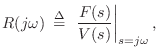
 and
and  denote the Laplace transforms of and
. In the case of a rigidly terminated string above, as well as
in any system in which all energy delivered to the system is
ultimately reflected back to the input, the impedance is purely
imaginary at every frequency (a ``pure reactance''), as is easy to show:
denote the Laplace transforms of and
. In the case of a rigidly terminated string above, as well as
in any system in which all energy delivered to the system is
ultimately reflected back to the input, the impedance is purely
imaginary at every frequency (a ``pure reactance''), as is easy to show:

 denotes the string length. Let
  denote the period
of string vibration. Then on the frequency axis
denote the period
of string vibration. Then on the frequency axis  we have

 axis. Impedance will be discussed further in
§7.1 below.
axis. Impedance will be discussed further in
§7.1 below.
Next Section:
The Ideal Plucked String
Previous Section:
Rigid Terminations