Multiband Delay-Filter Design
In §3.7.5, we derived first-order FDN delay-line filters which
can independently set the reverberation time at dc and at half the
sampling rate. However, perceptual studies indicate that
reverberation time should be independently adjustable in at least
three frequency bands [217]. To provide this degree
of control (and more), one can implement a multiband delay-line filter
using a general-purpose filter bank
[370,500]. The output, say, of each delay
line is split into  bands, where
  is recommended, and then,
from Eq.
is recommended, and then,
from Eq. (3.6), the gain in the
  th band for a length
  delay-line can be set to

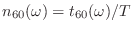 denotes the desired 60-dB decay
time in samples. Faust implementations of FDN reverberator along
these lines are described in §3.7.9 below.
denotes the desired 60-dB decay
time in samples. Faust implementations of FDN reverberator along
these lines are described in §3.7.9 below.
Next Section:
Zita-Rev1 Delay-Line Filters
Previous Section:
Orthogonalized First-Order Delay-Filter Design