Newton's Method of Nonlinear Minimization
Newton's method [162],[166, p. 143] finds the minimum of a nonlinear (scalar) function of several variables by locally approximating the function by a quadratic surface, and then stepping to the bottom of that ``bowl'', which generally requires a matrix inversion. Newton's method therefore requires the function to be ``close to quadratic'', and its effectiveness is directly tied to the accuracy of that assumption. For smooth functions, Newton's method gives very rapid quadratic convergence in the last stages of iteration. Quadratic convergence implies, for example, that the number of significant digits in the minimizer approximately doubles each iteration.
Newton's method may be derived as follows: Suppose we wish to minimize
the real, positive function
 with respect to
 . The
vector Taylor expansion [546] of
about
. The
vector Taylor expansion [546] of
about
 gives
gives

 , where
 . It is now necessary to assume that
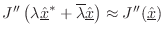 .
Differentiating with respect to
.
Differentiating with respect to
 , where
 is presumed
to be minimized, this becomes
is presumed
to be minimized, this becomes
 yields
![$\displaystyle \underline{\hat{x}}^\ast = \underline{\hat{x}}- [J''(\underline{\hat{x}})]^{-1} J^\prime(\underline{\hat{x}}).$](http://www.dsprelated.com/josimages_new/pasp/img1719.png)
Applying Eq.
 (7.13) iteratively, we obtain Newton's method:
![$\displaystyle \underline{\hat{x}}_{n+1} = \underline{\hat{x}}_n - [J''(\underline{\hat{x}}_n)]^{-1} J^\prime(\underline{\hat{x}}_n), \quad n=1,2,\ldots\,,$](http://www.dsprelated.com/josimages_new/pasp/img1720.png)
where
 is given as an initial condition.
When the
 is any quadratic form in
, then
is any quadratic form in
, then
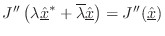 , and
Newton's method produces
in one iteration; that is,
, and
Newton's method produces
in one iteration; that is,
 for every
.
for every
.
Next Section:
Semi-Implicit Methods
Previous Section:
Trapezoidal Rule