







One-Zero Loop Filter
If we relax the constraint that
 be odd, then the simplest case
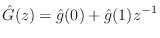
becomes the one-zero digital filter:
be odd, then the simplest case
becomes the one-zero digital filter:
 , the filter is linear phase, and its phase
delay and group delay are equal to
, the filter is linear phase, and its phase
delay and group delay are equal to  sample [362].
In practice, the half-sample delay must be compensated elsewhere in
the filtered delay loop, such as in the delay-line interpolation
filter [207]. Normalizing the dc gain to unity
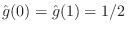
removes the last degree of freedom so that
sample [362].
In practice, the half-sample delay must be compensated elsewhere in
the filtered delay loop, such as in the delay-line interpolation
filter [207]. Normalizing the dc gain to unity
removes the last degree of freedom so that
 ,
and
,
and
 .
.
See [454] for related discussion from a software implementation perspective.
Next Section:
The Karplus-Strong Algorithm
Previous Section:
Length FIR Loop Filter Controlled by ``Brightness'' and ``Sustain''












