PDEs
A partial differential equation (PDE) extends ODEs by adding
one or more independent variables (usually spatial variables). For
example, the wave equation for the ideal vibrating string adds one
spatial dimension  (along the axis of the string) and may be written as
follows:
(along the axis of the string) and may be written as
follows:
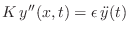 (Restoring Force = Inertial Force) (Restoring Force = Inertial Force) |
(2.1) |
where
 denotes the transverse displacement of the
string at position along the string and time
denotes the transverse displacement of the
string at position along the string and time  , and
, and
 denotes the
partial derivative of
denotes the
partial derivative of  with respect to
.2.7 The
physical parameters in this case are string tension
with respect to
.2.7 The
physical parameters in this case are string tension  and string
mass-density
and string
mass-density  . This PDE is the starting point for both digital
waveguide models (Chapter 6) and finite difference schemes
(§C.2.1).
. This PDE is the starting point for both digital
waveguide models (Chapter 6) and finite difference schemes
(§C.2.1).
Next Section:
Difference Equations (Finite Difference Schemes)
Previous Section:
ODEs