Passive One-Ports
It is well known that the impedance of every passive one-port is positive real (see §C.11.2). The reciprocal of a positive real function is positive real, so every passive impedance corresponds also to a passive admittance.
A complex-valued function of a complex variable  is said to be
positive real (PR) if
is said to be
positive real (PR) if
- 1)
- is real whenever
 is real
- 2)
-
 whenever
 .
.
A particularly important property of positive real
functions is that the phase is bounded between plus and minus  degrees, i.e.,
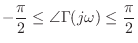 . One
implication is that in the lossless case (no dashpots, only masses and
springs--a reactance) all poles and zeros interlace along the
. One
implication is that in the lossless case (no dashpots, only masses and
springs--a reactance) all poles and zeros interlace along the
 axis, as depicted in Fig.7.14.
![\includegraphics[width=\twidth]{eps/interlace}](http://www.dsprelated.com/josimages_new/pasp/img1637.png) |
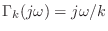 ) gives a
  phase shift, while
that of a mass (
phase shift, while
that of a mass (
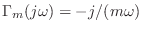 ) gives a
  phase shift between the input driving-
Referring to Fig.7.14, consider the graphical method for
computing phase response of a reactance from the pole zero diagram
[449].8.4Each zero on the positive axis contributes a net 90 degrees
of phase at frequencies above the zero. As frequency crosses the zero
going up, there is a switch from  to
to  degrees. For each
pole, the phase contribution switches from to degrees as
it is passed going up in frequency. In order to keep phase in
degrees. For each
pole, the phase contribution switches from to degrees as
it is passed going up in frequency. In order to keep phase in
![$ [-\pi/2,\pi/2]$](http://www.dsprelated.com/josimages_new/pasp/img1640.png) , it is clear that the poles and zeros must strictly
alternate. Moreover, all poles and zeros must be simple, since a
multiple poles or zero would swing the phase by more than
, it is clear that the poles and zeros must strictly
alternate. Moreover, all poles and zeros must be simple, since a
multiple poles or zero would swing the phase by more than  degrees, and the reactance could not be positive real.
The positive real property is fundamental to passive immittances and comes up often in the study of measured resonant systems. A practical modeling example (passive digital modeling of a guitar bridge) is discussed in §9.2.1.
Next Section:
Finite Difference Approximation
Previous Section:
General One-Ports