Passive Reflectances
From Eq. (C.75),
we have that the reflectance seen at a continuous-time impedance
(C.75),
we have that the reflectance seen at a continuous-time impedance
 is given for force waves by
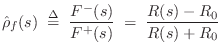
where
 is the wave impedance connected to the impedance ,
and the corresponding velocity reflectance is
is the wave impedance connected to the impedance ,
and the corresponding velocity reflectance is
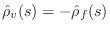 .
As mentioned above, all passive impedances are positive real.
As shown in §C.11.2, is positive real if and only
if
.
As mentioned above, all passive impedances are positive real.
As shown in §C.11.2, is positive real if and only
if
 is stable and has magnitude less than or equal to
  on
the
on
the  axis (and hence over the entire left-half plane, by the
maximum modulus theorem), i.e.,
axis (and hence over the entire left-half plane, by the
maximum modulus theorem), i.e.,
 re
re
In particular,
 for all radian
frequencies
for all radian
frequencies
 . Any stable
satisfying Eq.(C.77) may be called a passive reflectance.
. Any stable
satisfying Eq.(C.77) may be called a passive reflectance.
If the impedance goes to infinity (becomes rigid), then
approaches , a result which agrees with an analysis of
rigid string terminations (p. ![[*]](../icons/crossref.png) ). Similarly, when the
impedance goes to zero,
becomes
). Similarly, when the
impedance goes to zero,
becomes  , which agrees with
the physics of a string with a free end. In acoustic stringed
instruments, bridges are typically quite rigid, so that
, which agrees with
the physics of a string with a free end. In acoustic stringed
instruments, bridges are typically quite rigid, so that
 for all
  . If a body resonance is
strongly coupled through the bridge,
. If a body resonance is
strongly coupled through the bridge,
 can be
significantly smaller than 1 at the resonant frequency
can be
significantly smaller than 1 at the resonant frequency  .
.
Solving for in Eq.(C.77), we can characterize every
impedance in terms of its reflectance:
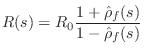 (C.76) in the form
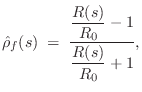 to the ``old'' impedance in which the
incoming waves travel. In other words, the incoming waves see the
wave impedance ``step'' from to , which results in a
``scattering'' of the incident wave into reflected and transmitted
components, as discussed in §C.8. The reflection and
transmission coefficients depend on frequency when
to the ``old'' impedance in which the
incoming waves travel. In other words, the incoming waves see the
wave impedance ``step'' from to , which results in a
``scattering'' of the incident wave into reflected and transmitted
components, as discussed in §C.8. The reflection and
transmission coefficients depend on frequency when
 is
not constant with respect to .
is
not constant with respect to .
In the discrete-time case, which may be related to the continuous-time
case by the bilinear transform (§7.3.2), we have the same basic
relations, but in the  plane:


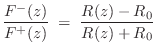


where
 denotes admittance, with
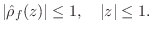
Mathematically, any stable transfer function having these properties may be called a Schur function. Thus, the discrete-time reflectance
 of an impedance
  is a Schur function if
and only if the impedance is passive (positive real).
is a Schur function if
and only if the impedance is passive (positive real).
Note that Eq.(C.79) may be obtained from the general formula for
scattering at a loaded waveguide junction for the case of a single
waveguide ( ) terminated by a lumped load (§C.12).
In the limit as damping goes to zero (all poles of converge to
the unit circle),
the reflectance
becomes a digital allpass filter. Similarly,
becomes a continuous-time allpass filter as the poles of
approach the axis.
Recalling that a lossless impedance is called a reactance
(§7.1), we can say that every reactance gives rise to an
allpass reflectance. Thus, for example, waves reflecting off a
mass at the end of a vibrating string will be allpass filtered,
because the driving-point impedance of a mass ( ) is a pure
reactance. In particular, the force-wave reflectance of a mass
) is a pure
reactance. In particular, the force-wave reflectance of a mass  terminating an ideal string having wave impedance is
 , which is a continuous-time allpass filter having
a pole at
, which is a continuous-time allpass filter having
a pole at  and a zero at
  .
.
It is intuitively reasonable that a passive reflection gain cannot
exceed at any frequency (i.e., the reflectance is a Schur filter,
as defined in Eq.(C.79)). It is also reasonable that lossless
reflection would have a gain of 1 (i.e., it is allpass).
Note that reflection filters always have an equal number of poles and
zeros, as can be seen from Eq.(C.76) above. This property is
preserved by the bilinear transform, so it holds in both the
continuous- and discrete-time cases.
Reflectance and Transmittance of a Yielding String Termination
 .
.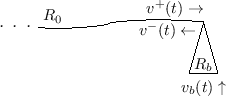
Consider the special case of a reflection and transmission at a
yielding termination, or ``bridge'', of an ideal vibrating
string on its right end, as shown in Fig.C.28. Denote the
incident and reflected velocity waves by  and
and  ,
respectively, and similarly denote the force-wave components by
,
respectively, and similarly denote the force-wave components by
 and
and
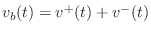
 . Finally, denote the velocity of the
termination itself by
. Finally, denote the velocity of the
termination itself by
 , and its force-wave
reflectance by
, and its force-wave
reflectance by
 denotes the string wave impedance.
The bridge velocity is given by


![$\displaystyle \hat{\tau}_f(s) \isdefs \frac{F_b(s)}{F^{+}(s)}
\eqsp \frac{R_0[V^{+}(s)-V^{-}(s)]}{R_0V^{+}(s)}
\eqsp 1+\hat{\rho}_f(s)
$](http://www.dsprelated.com/josimages_new/pasp/img3757.png)
 where
where  and
and  denote the
string tension and slope, respectively.
denote the
string tension and slope, respectively.
Power-Complementary Reflection and Transmission
We can show that the reflectance and transmittance of the yielding termination are power complementary. That is, the reflected and transmitted signal-power sum to yield the incident signal-power.
The average power incident at the bridge at frequency can be
expressed in the frequency domain as
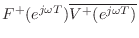 .
The reflected power is then
.
The reflected power is then
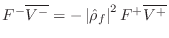 . Removing the minus sign, which can be
associated with reversed direction of travel, we obtain that the
power reflection frequency response is
. Removing the minus sign, which can be
associated with reversed direction of travel, we obtain that the
power reflection frequency response is
 , which
generalizes by analytic continuation to
, which
generalizes by analytic continuation to
 . The power
transmittance is given by
. The power
transmittance is given by

 plane as
![$\displaystyle F_b(s)V_b(-s) = \left[1-\hat{\rho}_f(s)\hat{\rho}_f(-s)\right]F^{+}(s)V^{+}(-s)
$](http://www.dsprelated.com/josimages_new/pasp/img3764.png)

Next Section:
Positive Real Functions
Previous Section:
Reflectance of an Impedance