Passive String Terminations
When a traveling wave reflects from the bridge of a real stringed
instrument, the bridge moves, transmitting sound energy into the
instrument body. How far the bridge moves is determined by the
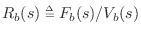
driving-point impedance of the bridge, denoted  . The
driving point impedance is the ratio of Laplace transform of the force
on the bridge
. The
driving point impedance is the ratio of Laplace transform of the force
on the bridge  to the velocity of motion that results
 . That is,
 .
.
For passive systems (i.e., for all unamplified acoustic musical
instruments), the driving-point impedance is positive
real (a property defined and discussed in §C.11.2). Being
positive real has strong implications on the nature of . In
particular, the phase of
 cannot exceed plus or minus
 degrees at any frequency, and in the lossless case, all poles and
zeros must interlace along the
degrees at any frequency, and in the lossless case, all poles and
zeros must interlace along the  axis. Another
implication is that the reflectance of a passive bridge, as
seen by traveling waves on the string, is a so-called Schur
function (defined and discussed in §C.11); a Schur
reflectance is a stable filter having gain not exceeding 1 at any
frequency. In summary, a guitar bridge is passive if and only if its
driving-point impedance is positive real and (equivalently) its
reflectance is Schur. See §C.11 for a fuller discussion of
this point.
axis. Another
implication is that the reflectance of a passive bridge, as
seen by traveling waves on the string, is a so-called Schur
function (defined and discussed in §C.11); a Schur
reflectance is a stable filter having gain not exceeding 1 at any
frequency. In summary, a guitar bridge is passive if and only if its
driving-point impedance is positive real and (equivalently) its
reflectance is Schur. See §C.11 for a fuller discussion of
this point.
At  , the force on the bridge is given by (§C.7.2)

 is the string tension as in Chapter 6, and
 is the slope of the string at . In the Laplace
frequency domain, we have
is the slope of the string at . In the Laplace
frequency domain, we have


Next Section:
A Terminating Resonator
Previous Section:
Software for Cubic Nonlinear Distortion