Piano String Wave Equation
A wave equation suitable for modeling linearized piano strings is given by [77,45,317,517]

where the partial derivative notation
 and
and  are defined on
page
are defined on
page ![[*]](../icons/crossref.png) , and
, and
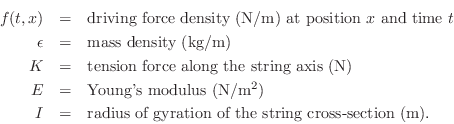
Young's modulus and the radius of gyration are defined in Appendix B.
The first two terms on the right-hand side of Eq. (9.30) come from
the ideal string wave equation (see Eq.(C.1)), and they model
transverse acceleration and transverse restoring force due to tension,
respectively. The term
(9.30) come from
the ideal string wave equation (see Eq.(C.1)), and they model
transverse acceleration and transverse restoring force due to tension,
respectively. The term  approximates the transverse
restoring force exerted by a stiff string when it is bent. In an
ideal string with zero diameter, this force is zero; in an ideal
rod (or bar), this term is dominant [317,261,169].
The final two terms provide damping. The damping associated
with
approximates the transverse
restoring force exerted by a stiff string when it is bent. In an
ideal string with zero diameter, this force is zero; in an ideal
rod (or bar), this term is dominant [317,261,169].
The final two terms provide damping. The damping associated
with  is frequency-independent, while the damping due
  increases with frequency.
Next Section:
Damping-Filter Design
Previous Section:
Feathering