Positive Real Functions
Any passive driving-point impedance, such as the impedance of a
violin bridge, is positive real. Positive real functions have
been studied extensively in the continuous-time case in the context of
network synthesis [68,524]. Very little, however, seems
to be available in the discrete time case. This section (reprinted
from [428]) summarizes the main properties of positive real
function in the  plane (i.e., the discrete-time case).
Definition.
A complex valued function of a complex variable  is said to be
positive real (PR) if
is said to be
positive real (PR) if

 re
re
We now specialize to the subset of functions representable as a
ratio of finite-order polynomials in . This class of ``rational''
functions is the set of all transfer functions of finite-order
time-invariant linear systems, and we write  to denote a member
of this class. We use the convention that stable, minimum phase
systems are analytic and nonzero in the strict outer
disk.C.8 Condition (1) implies
that for to be PR, the polynomial coefficients must be real,
and therefore complex poles and zeros must exist in conjugate
pairs. We assume from this point on that
to denote a member
of this class. We use the convention that stable, minimum phase
systems are analytic and nonzero in the strict outer
disk.C.8 Condition (1) implies
that for to be PR, the polynomial coefficients must be real,
and therefore complex poles and zeros must exist in conjugate
pairs. We assume from this point on that
 satisfies (1).
From (2) we derive the facts below.
satisfies (1).
From (2) we derive the facts below.
Property 1. A real rational function is PR iff
 .
.
Proof. Expressing in polar form gives
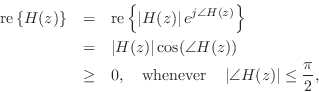
since the zeros of are isolated.

Property 2. is PR iff  is PR.
Proof. Assuming is PR, we have by Property 1,

Property 3. A PR function is analytic and nonzero in
the strict outer disk.
Proof. (By contradiction)
Without loss of generality, we treat only  order polynomials

 .
Since facts about
.
Since facts about
 are readily deduced from facts about
, we set
are readily deduced from facts about
, we set
 at no great loss.
The general (normalized) causal, finite-order, linear,
time-invariant transfer function may be written


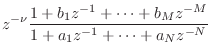
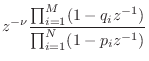

where
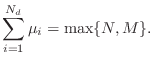
 is the number of distinct poles, each of multiplicity
  ,and
,and
Suppose there is a pole of multiplicity  outside the unit circle.
Without loss of generality, we may set
outside the unit circle.
Without loss of generality, we may set  , and
, and
 with
with  . Then for near
  , we have

Consider the circular neighborhood of radius  described by
 . Since we may
choose
. Since we may
choose
 so that all points in this neighborhood lie
outside the unit circle. If we write the residue of the factor
so that all points in this neighborhood lie
outside the unit circle. If we write the residue of the factor
 in polar form as
 , then we have,
for sufficiently small ,
, then we have,
for sufficiently small ,

Therefore, approaching the pole
 at an angle
  gives
gives

 , or the pole angle
  ( cannot be zero by
hypothesis).
We thus conclude that a PR function can have no poles in the outer disk.
By Property 2, we conclude that positive real functions must be minimum phase.
( cannot be zero by
hypothesis).
We thus conclude that a PR function can have no poles in the outer disk.
By Property 2, we conclude that positive real functions must be minimum phase.
Corollary. In equation Eq. (C.80),
  .
.
Proof. If  , then there are
  poles at
infinity. As
poles at
infinity. As
 ,
,
 , we must have .
Corollary. The log-magnitude of a PR function has zero mean on the unit circle.
This is a general property of stable, minimum-phase transfer functions which follows immediately from the argument principle [297,326].
Corollary. A rational PR function has an equal number of poles and zeros all of which are in the unit disk.
This really a convention for numbering poles and zeros. In Eq.(C.80),
we have , and all poles and zeros inside the unit disk. Now, if
 then we have
  extra poles at
  induced by the numerator.
If
induced by the numerator.
If  , then
  zeros at the origin appear from the denominator.
Corollary. Every pole on the unit circle of a positive real function must be simple with a real and positive residue.
Proof.
We repeat the previous argument using a semicircular neighborhood of
radius about the point
 to obtain

In order to have
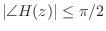 near this pole,
it is necessary that
near this pole,
it is necessary that  and
and  .
.
Corollary.
If is PR with a zero at
 , then
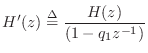
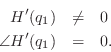
Proof. We may repeat the above for .
Property. Every PR function has a causal inverse z transform  .
.
Proof. This follows immediately from analyticity in the outer disk
[342, pp. 30-36]
However, we may give a more concrete proof as follows.
Suppose is non-causal. Then there exists
 such that
 .
We have,
.
We have,

Hence, has at least one pole at infinity and cannot be PR by Property 3.
Note that this pole at infinity cannot be cancelled since otherwise
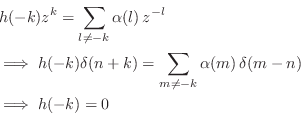
which contradicts the hypothesis that is non-causal.
Property.
is PR iff it is analytic for
 , poles on the
unit circle are simple with real and positive residues, and
re
, poles on the
unit circle are simple with real and positive residues, and
re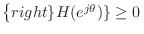 for
for
 .
.
Proof. If is positive real, the conditions stated hold by virtue
of Property 3 and the definition of positive real.
To prove the converse, we first show nonnegativity on the upper semicircle implies nonnegativity over the entire circle.
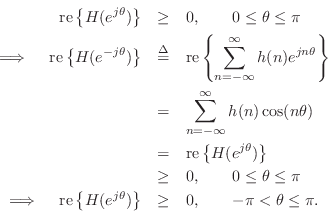
Alternatively, we might simply state that
real implies
re is even in
  .
.
Next, since the function  is analytic everywhere except at
 , it follows that
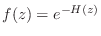 is analytic wherever
is finite. There are no poles of outside the unit
circle due to the analyticity assumption, and poles on the unit circle
have real and positive residues. Referring again to the limiting form
Eq.(C.81) of near a pole on the unit circle at
is analytic wherever
is finite. There are no poles of outside the unit
circle due to the analyticity assumption, and poles on the unit circle
have real and positive residues. Referring again to the limiting form
Eq.(C.81) of near a pole on the unit circle at  ,
we see that, as
,
we see that, as
 , we have
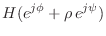

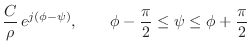




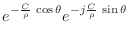

since the residue
 is positive, and the net angle does not
exceed
is positive, and the net angle does not
exceed  . From Eq.(C.83) we can state that for points
 with modulus
  , we have For all
 , there
exists
, there
exists  such that
 . Thus is analytic in the strict
outer disk, and continuous up to the unit circle which forms its
boundary. By the maximum modulus theorem [83],
. Thus is analytic in the strict
outer disk, and continuous up to the unit circle which forms its
boundary. By the maximum modulus theorem [83],

 re
re re
re
For example, if a transfer function is known to be asymptotically stable, then a frequency response with nonnegative real part implies that the transfer function is positive real.
Note that consideration of leads to analogous necessary and sufficient
conditions for to be positive real in terms of its
zeros instead of poles.
Relation to Stochastic Processes
Property.
If a stationary random process  has a rational power spectral
density
has a rational power spectral
density
 corresponding to an autocorrelation function
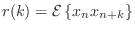 , then
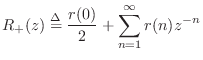
Proof.
By the representation theorem [19, pp. 98-103] there exists
an asymptotically stable filter
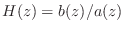 which will produce a
realization of when driven by white noise, and we have
which will produce a
realization of when driven by white noise, and we have
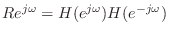 . We define the analytic continuation
of
by
. We define the analytic continuation
of
by
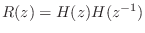 . Decomposing
  into a sum of
causal and anti-causal components gives
into a sum of
causal and anti-causal components gives

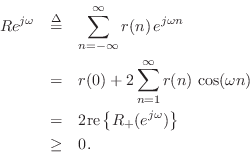
where  is found by equating coefficients of like powers of in

Since the poles of and  are the same,
it only remains to be shown that
re
are the same,
it only remains to be shown that
re .
.
Since spectral power is nonnegative,
 for all
  , and so
Relation to Schur Functions
Definition. A Schur function  is defined as a complex function analytic and of modulus not exceeding
unity in
is defined as a complex function analytic and of modulus not exceeding
unity in  .
.
Property. The function
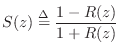
is a Schur function if and only if
is positive real.
Proof.
Suppose is positive real. Then for  ,
re
,
re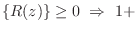 re
re is PR. Consequently,
  is minimum phase which implies all roots of lie in the unit circle.
Thus is analytic in . Also,
is minimum phase which implies all roots of lie in the unit circle.
Thus is analytic in . Also,
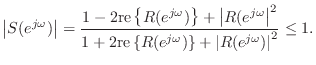 takes on its maximum value in
on the boundary. Thus is Schur.
takes on its maximum value in
on the boundary. Thus is Schur.
Conversely, suppose is Schur. Solving Eq.(C.84) for
and taking the real part on the unit circle yields
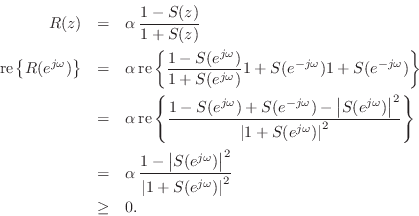
If
 is constant, then
 is PR. If is not
constant, then by the maximum principle,
is PR. If is not
constant, then by the maximum principle,  for
for  . By
Rouche's theorem applied on a circle of radius
. By
Rouche's theorem applied on a circle of radius
 ,
, on
which
,
, on
which  , the function
  has the same number of
zeros as the function
has the same number of
zeros as the function  in
in
 . Hence, is
minimum phase which implies is analytic for
. Hence, is
minimum phase which implies is analytic for  . Thus
is PR.
. Thus
is PR.
Relation to functions positive real in the right-half plane
Property.
re for
for
 whenever
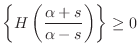
 , where
  is any positive real number.
Proof.
We shall show that the change of variable
 ,
provides a conformal map from the z-plane to the s-plane that takes the
region
to the region
re. The general formula for a
bilinear conformal mapping of functions of a complex variable is given by
,
provides a conformal map from the z-plane to the s-plane that takes the
region
to the region
re. The general formula for a
bilinear conformal mapping of functions of a complex variable is given by

In general, a bilinear transformation maps circles and lines into circles
and lines [83]. We see that the choice of three specific points
and their images determines the mapping for all  and .
We must have that the imaginary axis in the s-plane maps to the unit circle
in the z-plane.
That is, we may determine the mapping by three points of the form
and .
We must have that the imaginary axis in the s-plane maps to the unit circle
in the z-plane.
That is, we may determine the mapping by three points of the form
 and
and
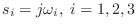 .
If we predispose one such mapping by choosing the pairs
.
If we predispose one such mapping by choosing the pairs
 and
and
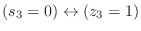 , then we are left with
transformations of the form
, then we are left with
transformations of the form


Letting
 be some point
  on the imaginary axis,
and
on the imaginary axis,
and  be some point
 on the unit circle, we find that
 is real. To avoid degeneracy, we require
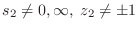 , and this translates to finite and
nonzero. Finally, to make the unit disk map to the left-half s-plane,
and must have the same sign in which case
, and this translates to finite and
nonzero. Finally, to make the unit disk map to the left-half s-plane,
and must have the same sign in which case  .
.
There is a bonus associated with the restriction that be real which
is that

We have therefore proven
Property.
 PR
PR PR
PR is any positive real number.
The class of mappings of the form Eq.(C.85) which take the exterior of
the unit circle to the right-half plane is larger than the class
Eq.(C.86). For example, we may precede the transformation
Eq.(C.86) by any
conformal map which takes the unit disk to the unit disk, and these
mappings have the algebraic form of a first order complex allpass
whose zero lies inside the unit circle.
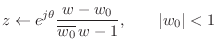
where
 is the zero of the allpass and the image (also pre-image)
of the origin, and is an angle of pure rotation. Note that
Eq.(C.88) is equivalent to a pure rotation, followed by a real
allpass substitution ( real), followed by a pure rotation. The
general preservation of condition (2) in Def. 2 forces the real axis
to map to the real axis. Thus rotations by other than
is the zero of the allpass and the image (also pre-image)
of the origin, and is an angle of pure rotation. Note that
Eq.(C.88) is equivalent to a pure rotation, followed by a real
allpass substitution ( real), followed by a pure rotation. The
general preservation of condition (2) in Def. 2 forces the real axis
to map to the real axis. Thus rotations by other than  are
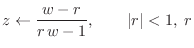
useless, except perhaps in some special cases. However, we may
precede Eq.(C.86) by the first order real allpass
substitution
are
useless, except perhaps in some special cases. However, we may
precede Eq.(C.86) by the first order real allpass
substitution
 real
real
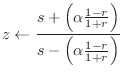 (C.86) up to a minus sign (rotation by
). By inspection of Eq.(C.85), it is clear that sign negation
corresponds to the swapping of points and
(C.86) up to a minus sign (rotation by
). By inspection of Eq.(C.85), it is clear that sign negation
corresponds to the swapping of points and  , or and
  .
Thus the only extension we have found by means of the general disk to
disk pre-transform, is the ability to interchange two of the three
points already tried. Consequently, we conclude that the largest
class of bilinear transforms which convert functions positive real in
the outer disk to functions positive real in the right-half plane is
characterized by
.
Thus the only extension we have found by means of the general disk to
disk pre-transform, is the ability to interchange two of the three
points already tried. Consequently, we conclude that the largest
class of bilinear transforms which convert functions positive real in
the outer disk to functions positive real in the right-half plane is
characterized by

Riemann's theorem may be used to show that Eq.
(C.89) is also the
largest such class of conformal mappings. It is not essential,
however, to restrict attention solely to conformal maps. The
pre-transform
 , for example, is not conformal and yet PR
is preserved.
, for example, is not conformal and yet PR
is preserved.
The bilinear transform is one which is used to map analog filters into
digital filters. Another such mapping is called the matched
transform [362]. It also preserves the positive real
property.
Property. is PR if  is positive real in the analog
sense, where
is positive real in the analog
sense, where  is interpreted as the sampling period.
Proof. The mapping
 takes the right-half -plane to
the outer disk in the -plane. Also is real if is
real. Hence PR implies PR. (Note, however, that
rational functions do not in general map to rational
functions.)
takes the right-half -plane to
the outer disk in the -plane. Also is real if is
real. Hence PR implies PR. (Note, however, that
rational functions do not in general map to rational
functions.)
These transformations allow application of the large battery of tests which exist for functions positive real in the right-half plane [524].
Special cases and examples
- The sum of positive real functions is positive real.
- The difference of positive real functions is conditionally positive real.
- The product or division of positive real functions is conditionally PR.
- PR
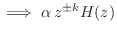 not PR for
 .
.
Minimum Phase (MP) polynomials in
All properties of MP polynomials apply without modification to marginally stable allpole transfer functions (cf. Property 2):
- Every first-order MP polynomial is positive real.
- Every first-order MP polynomial
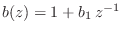 is such that
 is positive real.
- A PR second-order MP polynomial with complex-conjugate zeros,

satisfies
If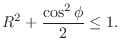
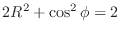 , then
re
, then
re has a double zero at
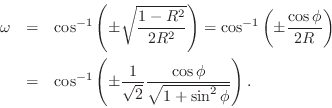
- All polynomials of the form
are positive real. (These have zeros uniformly distributed on a circle of radius

 .)
.)
Miscellaneous Properties
- If all poles and zeros of a PR function are on the unit circle,
then they alternate along the circle. Since this property is
preserved by the bilinear transform, it is true in both the
and planes. It can be viewed as a consequence of the
 phase bounds for positive-real functions.
- If
 is PR, then so is
 ,
where the prime denotes differentiation in .
,
where the prime denotes differentiation in .
Next Section:
Two Ideal Strings Coupled at an Impedance
Previous Section:
Passive Reflectances