Principal Axes of Rotation
A principal axis of rotation (or principal direction) is
an eigenvector of the mass moment of inertia tensor (introduced
in the previous section) defined relative to some point (typically the
center of mass). The corresponding eigenvalues are called the
principal moments of inertia.
Because the moment of inertia tensor is defined relative to the point
 in the space, the principal axes all pass through that point
(usually the center of mass).
in the space, the principal axes all pass through that point
(usually the center of mass).
As derived above (§B.4.14), the angular momentum vector is given by the moment of inertia tensor times the angular-velocity vector:

 is an eigenvector of
 , then we have
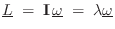
 is called a principal moment of
inertia. If we set the rigid body assocated with
rotating
about the axis
, then is the mass moment of inertia of
the body for that rotation. As will become clear below, there are
always three mutually orthogonal principal axes of rotation, and three
corresponding principal moments of inertia (in 3D space, of course).
is called a principal moment of
inertia. If we set the rigid body assocated with
rotating
about the axis
, then is the mass moment of inertia of
the body for that rotation. As will become clear below, there are
always three mutually orthogonal principal axes of rotation, and three
corresponding principal moments of inertia (in 3D space, of course).
Positive Definiteness of the Moment of Inertia Tensor
From the form of the moment of inertia tensor introduced in Eq. (B.24)
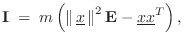 is symmetric. Moreover, for any normalized
angular-velocity vector
is symmetric. Moreover, for any normalized
angular-velocity vector
 we have
![\begin{eqnarray*}
I &=& \underline{\tilde{\omega}}^T\mathbf{I}\,\underline{\tild...
...\cal P}_{\underline{x}}(\underline{\tilde{\omega}})\right] \ge 0
\end{eqnarray*}](http://www.dsprelated.com/josimages_new/pasp/img2916.png)
since
is unit length, and projecting it onto any other vector
can only shorten it or leave it unchanged. That is,
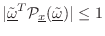 , with equality occurring for
 for any nonzero
 . Zooming out,
of course we expect any moment of inertia
. Zooming out,
of course we expect any moment of inertia  for a positive
mass
for a positive
mass  to be nonnegative. Thus,
is symmetric
nonnegative definite. If furthermore
and
to be nonnegative. Thus,
is symmetric
nonnegative definite. If furthermore
and
 are not
collinear, i.e., if there is any nonzero angle between them, then
is positive definite (and
are not
collinear, i.e., if there is any nonzero angle between them, then
is positive definite (and  ). As is well known in
linear algebra [329], real, symmetric, positive-definite
matrices have orthogonal eigenvectors and real, positive
eigenvalues. In this context, the orthogonal eigenvectors are
called the principal axes of rotation. Each corresponding
eigenvalue is the moment of inertia about that principal axis--the
corresponding principal moment of inertia. When angular velocity
vectors
are expressed as a linear combination of the principal
axes, there are no cross-terms in the moment of inertia tensor--no
so-called products of inertia.
). As is well known in
linear algebra [329], real, symmetric, positive-definite
matrices have orthogonal eigenvectors and real, positive
eigenvalues. In this context, the orthogonal eigenvectors are
called the principal axes of rotation. Each corresponding
eigenvalue is the moment of inertia about that principal axis--the
corresponding principal moment of inertia. When angular velocity
vectors
are expressed as a linear combination of the principal
axes, there are no cross-terms in the moment of inertia tensor--no
so-called products of inertia.
The three principal axes are unique when the eigenvalues of
(principal moments of inertia) are distinct. They are
not unique when there are repeated eigenvalues, as in the example
above of a disk rotating about any of its diameters
(§B.4.4). In that example, one principal
axis, the one corresponding to eigenvalue  , was
, was
 (i.e.,
orthogonal to the disk and passing through its center), while any two
orthogonal diameters in the plane of the disk may be chosen as the
other two principal axes (corresponding to the repeated eigenvalue
(i.e.,
orthogonal to the disk and passing through its center), while any two
orthogonal diameters in the plane of the disk may be chosen as the
other two principal axes (corresponding to the repeated eigenvalue
 ).
).
Symmetry of the rigid body about any axis
 (passing through the
origin) means that
is a principal direction. Such a symmetric
body may be constructed, for example, as a solid of
revolution.B.26In rotational dynamics, this case is known as the symmetric top
[270]. Note that the center of mass will lie
somewhere along an axis of symmetry. The other two principal axes can
be arbitrarily chosen as a mutually orthogonal pair in the (circular)
plane orthogonal to the
axis, intersecting at the
axis. Because of the circular symmetry about
, the two
principal moments of inertia in that plane are equal. Thus the moment
of inertia tensor can be diagonalized to look like
(passing through the
origin) means that
is a principal direction. Such a symmetric
body may be constructed, for example, as a solid of
revolution.B.26In rotational dynamics, this case is known as the symmetric top
[270]. Note that the center of mass will lie
somewhere along an axis of symmetry. The other two principal axes can
be arbitrarily chosen as a mutually orthogonal pair in the (circular)
plane orthogonal to the
axis, intersecting at the
axis. Because of the circular symmetry about
, the two
principal moments of inertia in that plane are equal. Thus the moment
of inertia tensor can be diagonalized to look like
![$\displaystyle \mathbf{I}= \left[\begin{array}{ccc}
I_1 & 0 & 0\\ [2pt]
0 & I_2 & 0\\ [2pt]
0 & 0 & I_2
\end{array}\right],
$](http://www.dsprelated.com/josimages_new/pasp/img2925.png)
 is the principal moment of inertia about
, and
is the principal moment of inertia about
, and
 is the (twice repeated) principal moment of inertia about the
two axes in the circular-symmetry plane. We saw in §B.4.5
(Perpendicular Axis theorem) that if the mass distribution is planar,
then
is the (twice repeated) principal moment of inertia about the
two axes in the circular-symmetry plane. We saw in §B.4.5
(Perpendicular Axis theorem) that if the mass distribution is planar,
then  .
.
Next Section:
Rotational Kinetic Energy Revisited
Previous Section:
Mass Moment of Inertia Tensor