Proof of Maximum Flatness at DC
The maximumally flat fractional-delay FIR filter is obtained by equating
to zero all  leading terms in the Taylor (Maclaurin) expansion of
the frequency-response error at dc:
leading terms in the Taylor (Maclaurin) expansion of
the frequency-response error at dc:
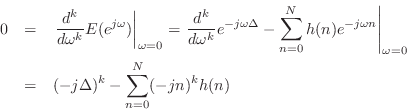
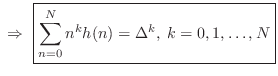
 , where
  is a Vandermonde matrix. The
solution can be written as a ratio of Vandermonde determinants using
Cramer's rule [329]. As shown by Cauchy (1812), the
determinant of a Vandermonde matrix
is a Vandermonde matrix. The
solution can be written as a ratio of Vandermonde determinants using
Cramer's rule [329]. As shown by Cauchy (1812), the
determinant of a Vandermonde matrix
![$ [p_i^{j-1}]$](http://www.dsprelated.com/josimages_new/pasp/img1063.png) ,
,
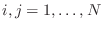 can be expressed in closed form as
![\begin{eqnarray*}
\left\vert\left[p_i^{j-1}\right]\right\vert &=& \prod_{j>i}(p_...
...ts\\
&&(p_{N-1}-p_{N-2})(p_N-p_{N-2})\cdots\\
&&(p_N-p_{N-1}).
\end{eqnarray*}](http://www.dsprelated.com/josimages_new/pasp/img1065.png)
Making this substitution in the solution obtained by Cramer's rule
yields that the impulse response of the order  , maximally flat,
fractional-delay FIR filter may be written in closed form as
, maximally flat,
fractional-delay FIR filter may be written in closed form as

 (4.6)) adapted to this problem (in which abscissae are
equally spaced on the integers from 0 to
(4.6)) adapted to this problem (in which abscissae are
equally spaced on the integers from 0 to  ).
).
Further details regarding the theory of Lagrange interpolation can be found (online) in [502, Ch. 3, Pt. 2, pp. 82-84].
Next Section:
Variable Filter Parametrizations
Previous Section:
Odd-Order Lagrange Interpolation Summary