Proof that the Third-Order Time Derivative is Ill Posed
For its tutorial value, let's also show that the PDE of Ruiz
[392] is ill posed, i.e., that at least one component of the
solution is a growing exponential. In this case, setting
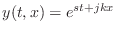 in Eq.
 (C.28), which we restate as
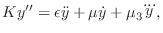

 -plane.
It is interesting to note that Ruiz discovered the exponentially growing solution, but simply dropped it as being non-physical. In the work of Chaigne and Askenfelt [77], it is believed that the finite difference approximation itself provided the damping necessary to eliminate the unstable solution [45]. (See §7.3.2 for a discussion of how finite difference approximations can introduce damping.) Since the damping effect is sampling-rate dependent, there is an upper bound to the sampling rate that can be used before an unstable mode appears.
Next Section:
DW Displacement Inputs
Previous Section:
A Class of Well Posed Damped PDEs