Radius of Gyration
For a planar distribution of mass rotating about some axis in the plane of the mass, the radius of gyration is the distance from the axis that all mass can be concentrated to obtain the same mass moment of inertia. Thus, the radius of gyration is the ``equivalent distance'' of the mass from the axis of rotation. In this context, gyration can be defined as rotation of a planar region about some axis lying in the plane.
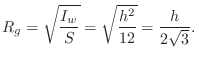
For a bar cross-section with area  , the radius of gyration is given by

where
 is the area moment of inertia (§B.4.8)
of the cross-section about a given axis of rotation lying in the plane
of the cross-section (usually passing through its centroid):
is the area moment of inertia (§B.4.8)
of the cross-section about a given axis of rotation lying in the plane
of the cross-section (usually passing through its centroid):
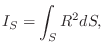
 denotes the distance of the differential area element
  from the axis of gyration.
Rectangular Cross-Section
For a rectangular cross-section of height  and width
  , area
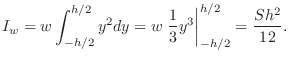
 , the area moment of inertia about the horizontal midline is
given by
, the area moment of inertia about the horizontal midline is
given by
 .
.
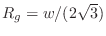
The radius of gyration can be thought of as the ``effective radius'' of the mass distribution with respect to its inertial response to rotation (``gyration'') about the chosen axis.
Most cross-sectional shapes (e.g., rectangular), have at least two radii of gyration. A circular cross-section has only one, and its radius of gyration is equal to half its radius, as shown in the next section.
Circular Cross-Section
For a circular cross-section of radius  , Eq.
, Eq. (B.11) tells us
that the squared radius of gyration about any line passing through the
center of the cross-section is given by
(B.11) tells us
that the squared radius of gyration about any line passing through the
center of the cross-section is given by
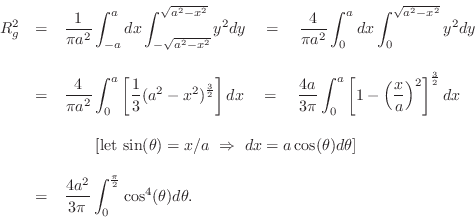
Using the elementrary trig identity
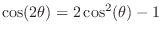 , we readily
derive
, we readily
derive

 , while the last term contributes
  ,
yielding
,
yielding
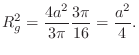 is
is

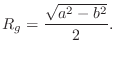
For a circular tube in which the mass of the cross-section lies
within a circular annulus having inner radius  and outer
radius , the radius of gyration is given by
and outer
radius , the radius of gyration is given by
Next Section:
Two Masses Connected by a Rod
Previous Section:
Area Moment of Inertia