







Reactive Terminations
In typical string models for virtual musical instruments, the ``nut
end'' of the string is rigidly clamped while the ``bridge end'' is
terminated in a passive reflectance  . The condition
for passivity of the reflectance is simply that its gain be bounded
by 1 at all frequencies [447]:
. The condition
for passivity of the reflectance is simply that its gain be bounded
by 1 at all frequencies [447]:

A very simple case, used, for example, in the Karplus-Strong plucked-string algorithm, is the two-point-average filter:
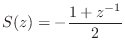


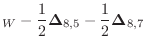
![\begin{eqnarray*}
\mbox{$\stackrel{{\scriptscriptstyle \vdash\!\!\dashv}}{\mathb...
... \\
0 & 0 & 0 & 0 & -1/2 & 1/2 & -1 & -1
\end{array}\!\right].
\end{eqnarray*}](http://www.dsprelated.com/josimages_new/pasp/img4722.png)
This gives the desired filter in a half-rate, staggered grid case. In the full-rate case, the termination filter is really
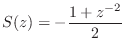
 (E.42), but it does not have
the desired amplitude response: Instead, it has a notch (gain of 0)
at one-fourth the sampling rate, and the gain comes back up to 1 at
half the sampling rate. In a full-rate scheme, the two-point-average
filter must straddle both subgrids.
(E.42), but it does not have
the desired amplitude response: Instead, it has a notch (gain of 0)
at one-fourth the sampling rate, and the gain comes back up to 1 at
half the sampling rate. In a full-rate scheme, the two-point-average
filter must straddle both subgrids.
Another often-used string termination filter in digital waveguide models is specified by [447]
![\begin{eqnarray*}
s(n) &=& -g\left[\frac{h}{4}, \frac{1}{2}, \frac{h}{4}\right]\...
...{j\omega T})&=&
-e^{-j\omega T}g\frac{1 + h \cos(\omega T)}{2},
\end{eqnarray*}](http://www.dsprelated.com/josimages_new/pasp/img4724.png)
where  is an overall gain factor that affects the decay
rate of all frequencies equally, while
is an overall gain factor that affects the decay
rate of all frequencies equally, while  controls the
relative decay rate of low-frequencies and high frequencies. An
advantage of this termination filter is that the delay is
always one sample, for all frequencies and for all parameter settings;
as a result, the tuning of the string is invariant with respect to
termination filtering. In this case, the perturbation is
controls the
relative decay rate of low-frequencies and high frequencies. An
advantage of this termination filter is that the delay is
always one sample, for all frequencies and for all parameter settings;
as a result, the tuning of the string is invariant with respect to
termination filtering. In this case, the perturbation is
 (E.41),
the order
(E.41),
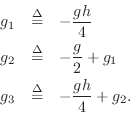
the order  FDTD state transition matrix is given by
![\begin{eqnarray*}
\mbox{$\stackrel{{\scriptscriptstyle \vdash\!\!\dashv}}{\mathb...
...d g_2 & \quad -g_2 & \quad g_3 & \quad -g_3
\end{array}\!\right]
\end{eqnarray*}](http://www.dsprelated.com/josimages_new/pasp/img4728.png)
where
The filtered termination examples of this section generalize
immediately to arbitrary finite-impulse response (FIR) termination
filters . Denote the impulse response of the termination filter
by
![$\displaystyle s(n)=[s_0,s_1,s_2,\ldots,s_N],
$](http://www.dsprelated.com/josimages_new/pasp/img4730.png)
 of the filter does not exceed
  . Due to
the DW-FDTD equivalence, the general stability condition is stated
very simply as
. Due to
the DW-FDTD equivalence, the general stability condition is stated
very simply as

Next Section:
Interior Scattering Junctions
Previous Section:
Boundary Conditions as Perturbations












