Reflectance of a General Lumped Waveguide Termination
Calculate the reflectance of the terminated waveguide. That is, find the Laplace transform of the return wave divided by the Laplace transform of the input wave going into the waveguide. In general, the reflectance of an impedance step for force waves (voltage waves in the electrical case) is
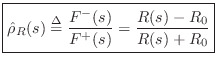
This is easily derived from continuity constraints across the junction. Specifically, referring to Fig.F.1b, let
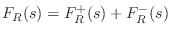 denote the physical force and its traveling-wave
components within the ``pseudo-infinitesimal-generalized-waveguide''
defined by the element impedance
denote the physical force and its traveling-wave
components within the ``pseudo-infinitesimal-generalized-waveguide''
defined by the element impedance  , with the `
 ' superscript
denoting a right-going wave.F.1 Similarly, let
' superscript
denoting a right-going wave.F.1 Similarly, let
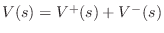 denote the velocity and its component wave variables on
the side of the junction at impedance
denote the velocity and its component wave variables on
the side of the junction at impedance  , and let
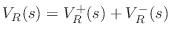 denote the corresponding quantities on the
element-side of the junction at impedance . Again, the `'
superscript denotes travel to the right. Then the physical continuity
constraints imply
denote the corresponding quantities on the
element-side of the junction at impedance . Again, the `'
superscript denotes travel to the right. Then the physical continuity
constraints imply

By the definition of wave impedance in a waveguide, we have
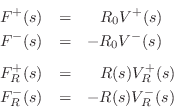
Thus,
![\begin{eqnarray*}
0 &=& V(s) + V_R(s)\\
&=& \left[V^{+}(s)+V^{-}(s)\right] + ...
...s)}\right]
&=& \frac{2}{R_0}F^{+}(s) + \frac{2}{R(s)}F^{+}_R(s)
\end{eqnarray*}](http://www.dsprelated.com/josimages_new/pasp/img4758.png)
Defining
 and
and
 , we have

Now that we've solved for the junction force
 , the outgoing
waves are simply obtained from the force continuity constraint,
, the outgoing
waves are simply obtained from the force continuity constraint,
 :
:


Finally, the force-wave reflectance of an impedance step from
to
can be found by solving Eq. (F.3) and (F.2) for
 with
with
 set to zero:
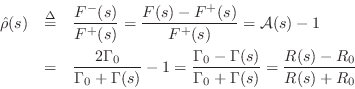
as claimed.
Next Section:
Reflectances of Elementary Impedances
Previous Section:
Interior Scattering Junctions