Reflection Coefficient, Parallel Case
The reflection coefficient seen at port  is defined as
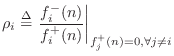
In other words, the reflection coefficient specifies what portion of the incoming wave
 is reflected back to port as
part of the outgoing wave
is reflected back to port as
part of the outgoing wave
 . The total outgoing wave on port
is the superposition of the reflected wave and the
. The total outgoing wave on port
is the superposition of the reflected wave and the  transmitted waves from the other ports:
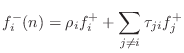
where
 denotes the transmission coefficient from
port
denotes the transmission coefficient from
port  to port . Starting with Eq.
 (F.19) and substituting
Eq.(F.18) gives
(F.19) and substituting
Eq.(F.18) gives
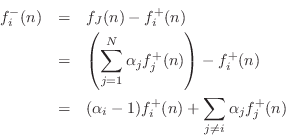
Equating like terms with Eq.(F.21), we obtain


Thus, the
th alpha parameter is the force transmission coefficient
from th port to any other port (besides the th). To convert the
transmission coefficient from the th port to the reflection
coefficient for that port, we simply subtract 1. This general
relationship is specific to force waves at a parallel junction, as we
will soon see.
Next Section:
Physical Derivation of Reflection Coefficient
Previous Section:
Alpha Parameters