Reflection Coefficient, Series Case
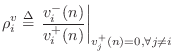
The velocity reflection coefficient seen at port
 is defined as
Representing the outgoing velocity wave
 as the
superposition of the reflected wave
as the
superposition of the reflected wave
 plus the
  transmitted waves from the other ports, we have
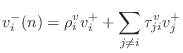
where
 denotes the velocity transmission
coefficientvelocity!transmission
coefficient from
port
denotes the velocity transmission
coefficientvelocity!transmission
coefficient from
port  to port . Substituting Eq.
 (F.29) into
Eq.(F.30) yields
(F.29) into
Eq.(F.30) yields
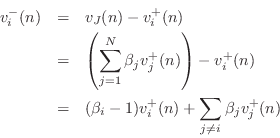
Equating like terms with Eq.(F.32) gives


Thus, the
th beta parameter is the velocity transmission
coefficient from th port to any other port (besides the th). To
convert the transmission coefficient from the th port to the
reflection coefficient for that port, we simply subtract 1. These
relationships are specific to velocity waves at a series junction
(cf. Eq.(F.22)). They are exactly the dual of Equations (F.22-F.23)
for force waves at a parallel junction.
Next Section:
Physical Derivation of Series Reflection Coefficient
Previous Section:
Beta Parameters