Relation of Lagrange to Sinc Interpolation
For an infinite number of equally spaced
samples, with spacing
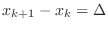 , the Lagrangian basis
polynomials converge to shifts of the sinc function, i.e.,
, the Lagrangian basis
polynomials converge to shifts of the sinc function, i.e.,


sinc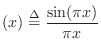
A simple argument is based on the fact that any analytic function is
determined by its zeros and its value at one point. Since
sinc
 is zero on all the integers except 0, and since
sinc
is zero on all the integers except 0, and since
sinc , it
must coincide with the infinite-order Lagrangian basis polynomial for
the sample at
, it
must coincide with the infinite-order Lagrangian basis polynomial for
the sample at  which also has its zeros on the nonzero integers
and equals
which also has its zeros on the nonzero integers
and equals  at .
at .
The equivalence of sinc interpolation to Lagrange interpolation was apparently first published by the mathematician Borel in 1899, and has been rediscovered many times since [309, p. 325].
A direct proof can be based on the equivalance between Lagrange
interpolation and windowed-sinc interpolation using a ``scaled
binomial window'' [262,502]. That is,
for a fractional sample delay of  samples, multiply the
shifted-by-, sampled, sinc function
samples, multiply the
shifted-by-, sampled, sinc function
 sinc
sinc![$\displaystyle (n-D) = \frac{\sin[\pi(n-D)]}{\pi(n-D)}
$](http://www.dsprelated.com/josimages_new/pasp/img1113.png)
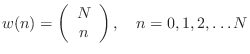
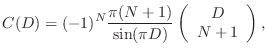
 norm, to
obtain the
norm, to
obtain the  th-order Lagrange interpolating filter

 ,
and since the window gets wider and wider, approaching a unit constant in
the limit, the convergence of Lagrange to sinc interpolation can be seen.
,
and since the window gets wider and wider, approaching a unit constant in
the limit, the convergence of Lagrange to sinc interpolation can be seen.
A more recent alternate proof appears in [557].
Next Section:
Thiran Allpass Interpolation in Matlab
Previous Section:
Recent Developments in Lagrange Interpolation