Rotating Horn Simulation
The heart of the Leslie effect is a rotating horn loudspeaker. The rotating horn from a Model 600 Leslie can be seen mounted on a microphone stand in Fig.5.7. Two horns are apparent, but one is a dummy, serving mainly to cancel the centrifugal force of the other during rotation. The Model 44W horn is identical to that of the Model 600, and evidently standard across all Leslie models [189]. For a circularly rotating horn, the source position can be approximated as
![$\displaystyle \underline{x}_s(t) = \left[\begin{array}{c} r_s\cos(\omega_m t) \\ [2pt] r_s\sin(\omega_m t) \end{array}\right] \protect$](http://www.dsprelated.com/josimages_new/pasp/img1293.png)
where
 is the circular radius and
  is angular velocity.
This expression ignores any directionality of the horn
radiation, and approximates the horn as an omnidirectional radiator
located at the same radius for all frequencies. In the Leslie, a
conical diffuser is inserted into the end of the horn in order to make
the radiation pattern closer to uniform [189], so the
omnidirectional assumption is reasonably accurate.6.10
is angular velocity.
This expression ignores any directionality of the horn
radiation, and approximates the horn as an omnidirectional radiator
located at the same radius for all frequencies. In the Leslie, a
conical diffuser is inserted into the end of the horn in order to make
the radiation pattern closer to uniform [189], so the
omnidirectional assumption is reasonably accurate.6.10
By Eq.
![\includegraphics[width=4.1in]{eps/hornrecordingr}](http://www.dsprelated.com/josimages_new/pasp/img1296.png)
 (5.3), the source velocity for the circularly rotating horn is
![$\displaystyle \underline{v}_s(t) = \frac{d}{dt}\underline{x}_s(t) = \left[\begi...
...in(\omega_m t) \\ [2pt] r_s\omega_m\cos(\omega_m t) \end{array}\right] \protect$](http://www.dsprelated.com/josimages_new/pasp/img1297.png)
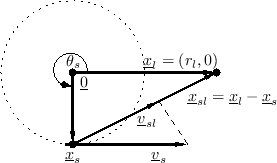
Note that the source velocity vector is always orthogonal to the source position vector, as indicated in Fig.5.8.
Since
 and
and
 are orthogonal,
the projected source velocity Eq.(5.4) simplifies to
are orthogonal,
the projected source velocity Eq.(5.4) simplifies to

Arbitrarily choosing
 (see Fig.5.8), and
substituting Eq.(5.8) and Eq.(5.9) into Eq.(5.10) yields
(see Fig.5.8), and
substituting Eq.(5.8) and Eq.(5.9) into Eq.(5.10) yields
![$\displaystyle \underline{v}_{sl}= \frac{-r_l r_s\omega_m\sin(\omega_m t)}{r_l^2...
...l-r_s\cos(\omega_m t) \\ [2pt] -r_s\sin(\omega_m)t \end{array}\right]. \protect$](http://www.dsprelated.com/josimages_new/pasp/img1302.png)
In the far field, this reduces simply to
![$\displaystyle \underline{v}_{sl}\approx -r_s\omega_m\sin(\omega_m t) \left[\begin{array}{c} 1 \\ [2pt] 0 \end{array}\right]. \protect$](http://www.dsprelated.com/josimages_new/pasp/img1303.png)
Substituting into the Doppler expression Eq.
(5.2)
with the listener velocity  set to zero yields
![$\displaystyle \omega_l = \frac{\omega_s }{1+r_s\omega_m\sin(\omega_m t)/c} \approx \omega_s \left[1-\frac{r_s\omega_m}{c}\sin(\omega_m t)\right], \protect$](http://www.dsprelated.com/josimages_new/pasp/img1305.png)
where the approximation is valid for small Doppler shifts. Thus, in the far field, a rotating horn causes an approximately sinusoidal multiplicative frequency shift, with the amplitude given by horn length
times horn angular velocity divided
by sound speed  . Note that
 is the
tangential speed of the assumed point of horn radiation.
is the
tangential speed of the assumed point of horn radiation.
Next Section:
Rotating Woofer-Port and Cabinet
Previous Section:
System Block Diagram