Stability of Nonlinear Feedback Loops
In general, placing a memoryless nonlinearity  in a stable
feedback loop preserves stability provided the gain of the
nonlinearity is less than one, i.e.,
in a stable
feedback loop preserves stability provided the gain of the
nonlinearity is less than one, i.e.,
 . A simple proof
for the case of a loop consisting of a continuous-time delay-line and
memoryless-nonlinearity is as follows.
. A simple proof
for the case of a loop consisting of a continuous-time delay-line and
memoryless-nonlinearity is as follows.
The delay line can be interpreted as a waveguide model of an ideal
string or acoustic pipe having wave impedance  and a noninverting
reflection at its midpoint. A memoryless nonlinearity is a special
case of an arbitrary time-varying gain [449]. By hypothesis,
this gain has magnitude less than one. By routing the output of the
delay line back to its input, the gain plays the role of a reflectance
and a noninverting
reflection at its midpoint. A memoryless nonlinearity is a special
case of an arbitrary time-varying gain [449]. By hypothesis,
this gain has magnitude less than one. By routing the output of the
delay line back to its input, the gain plays the role of a reflectance
 at the ``other end'' of the ideal string or acoustic pipe. We can
imagine, for example, a terminating dashpot with randomly varying
positive resistance
at the ``other end'' of the ideal string or acoustic pipe. We can
imagine, for example, a terminating dashpot with randomly varying
positive resistance  . The set of all
  corresponds to
the set of real reflection coefficients
corresponds to
the set of real reflection coefficients
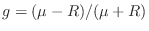 in the
open interval
in the
open interval  . Thus, each instantaneous nonlinearity-gain
 corresponds to some instantaneously positive resistance
. The whole system is therefore passive, even as
corresponds to some instantaneously positive resistance
. The whole system is therefore passive, even as  changes arbitrarily (while remaining positive). (It is perhaps easier
to ponder a charged capacitor
changes arbitrarily (while remaining positive). (It is perhaps easier
to ponder a charged capacitor  terminated on a randomly varying
resistor
terminated on a randomly varying
resistor  .) This proof method immediately extends to nonlinear
feedback around any transfer function that can be interpreted as the
reflectance of a passive physical system, i.e., any transfer function
.) This proof method immediately extends to nonlinear
feedback around any transfer function that can be interpreted as the
reflectance of a passive physical system, i.e., any transfer function
 for which the gain is bounded by 1 at each frequency, viz.,
 .
.
The finite-sampling-rate case can be embedded in a passive
infinite-sampling-rate case by replacing each sample with a constant
pulse lasting  seconds (in the delay line).
The continuous-time memoryless nonlinearity
seconds (in the delay line).
The continuous-time memoryless nonlinearity ![$ g[x(t)]$](http://www.dsprelated.com/josimages_new/pasp/img1554.png) is similarly a
held version of the discrete-time case
is similarly a
held version of the discrete-time case ![$ g[x(nT)]$](http://www.dsprelated.com/josimages_new/pasp/img1555.png) . Since the
discrete-time case is a simple sampling of the (passive)
continuous-time case, we are done.
. Since the
discrete-time case is a simple sampling of the (passive)
continuous-time case, we are done.
Next Section:
Practical Advice
Previous Section:
Cubic Soft-Clipper Spectrum