State-Space Analysis
We will now use state-space analysisC.15[449] to determine Equations (C.133-C.136).
![$\displaystyle x_1(n+1) = c[g x_1(n) + x_2(n)] - x_2(n) = c\,g x_1(n) + (c-1) x_2(n)
$](http://www.dsprelated.com/josimages_new/pasp/img4191.png)
![$\displaystyle x_2(n+1) = g x_1(n) + c[g x_1(n) + x_2(n)] = (1+c) g x_1(n) + c\,x_2(n)
$](http://www.dsprelated.com/josimages_new/pasp/img4192.png)
![$\displaystyle \left[\begin{array}{c} x_1(n+1) \\ [2pt] x_2(n+1) \end{array}\rig...
...bf{A} \left[\begin{array}{c} x_1(n) \\ [2pt] x_2(n) \end{array}\right] \protect$](http://www.dsprelated.com/josimages_new/pasp/img4193.png)
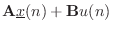
or, in vector notation,
 |
 |
 |
(C.137) |
 |
|
 |
(C.138) |
where we have introduced an input signal
 , which sums into the
state vector via the
, which sums into the
state vector via the  (or
(or
 ) vector
 . The
output signal is defined as the
. The
output signal is defined as the  vector
 times the
state vector
times the
state vector
 . Multiple outputs may be defined by choosing
to be an
. Multiple outputs may be defined by choosing
to be an
 matrix.
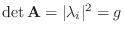
A basic fact from linear algebra is that the determinant of a
matrix is equal to the product of its eigenvalues. As a quick
check, we find that the determinant of  is
is

When the eigenvalues
 of
of
 (system poles) are complex, then
they must form a complex conjugate pair (since
is real), and we
have
(system poles) are complex, then
they must form a complex conjugate pair (since
is real), and we
have
 . Therefore, the system is
stable if and only if
. Therefore, the system is
stable if and only if  . When making a digital
sinusoidal oscillator from the system impulse response, we have
. When making a digital
sinusoidal oscillator from the system impulse response, we have
 , and the system can be said to be ``marginally stable''.
Since an undriven sinusoidal oscillator must not lose energy, and
since every lossless state-space system has unit-modulus eigenvalues
(consider the modal representation), we expect
, and the system can be said to be ``marginally stable''.
Since an undriven sinusoidal oscillator must not lose energy, and
since every lossless state-space system has unit-modulus eigenvalues
(consider the modal representation), we expect
 ,
which occurs for
,
which occurs for  .
.
Note that
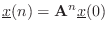 . If we diagonalize this system to
obtain
. If we diagonalize this system to
obtain
 , where
 diag
diag![$ [\lambda_1,\lambda_2]$](http://www.dsprelated.com/josimages_new/pasp/img4208.png) , and
, and
 is the matrix of eigenvectors
of
, then we have
is the matrix of eigenvectors
of
, then we have
![$\displaystyle \tilde{\underline{x}}(n) = \tilde{A}^n\,\tilde{\underline{x}}(0) ...
...eft[\begin{array}{c} \tilde{x}_1(0) \\ [2pt] \tilde{x}_2(0) \end{array}\right]
$](http://www.dsprelated.com/josimages_new/pasp/img4209.png)
 denotes the state vector in these
new ``modal coordinates''. Since
denotes the state vector in these
new ``modal coordinates''. Since  is diagonal, the modes are
decoupled, and we can write
is diagonal, the modes are
decoupled, and we can write
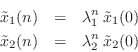
If this system is to generate a real sampled sinusoid at radian frequency
 , the eigenvalues
  and
and  must be of the form
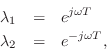
(in either order) where is real, and  denotes the sampling
interval in seconds.
denotes the sampling
interval in seconds.
Thus, we can determine the frequency of oscillation (and
verify that the system actually oscillates) by determining the
eigenvalues  of . Note that, as a prerequisite, it will
also be necessary to find two linearly independent eigenvectors of
(columns of
).
of . Note that, as a prerequisite, it will
also be necessary to find two linearly independent eigenvectors of
(columns of
).
Next Section:
Eigenstructure
Previous Section:
Digital Waveguide Resonator