State Transformations
In previous work, time-domain adaptors (digital filters) converting
between K variables and W variables have been devised
[223]. In this section, an alternative approach is
proposed. Mapping Eq. (E.7) gives us an immediate conversion from W
to K state variables, so all we need now is the inverse map for any
time
(E.7) gives us an immediate conversion from W
to K state variables, so all we need now is the inverse map for any
time  . This is complicated by the fact that non-local spatial
dependencies can go indefinitely in one direction along the string, as
we will see below. We will proceed by first writing down the
conversion from W to K variables in matrix form, which is easy to do,
and then invert that matrix. For simplicity, we will consider the
case of an infinitely long string.
. This is complicated by the fact that non-local spatial
dependencies can go indefinitely in one direction along the string, as
we will see below. We will proceed by first writing down the
conversion from W to K variables in matrix form, which is easy to do,
and then invert that matrix. For simplicity, we will consider the
case of an infinitely long string.
To initialize a K variable simulation for starting at time  , we
need initial spatial samples at all positions
, we
need initial spatial samples at all positions  for two successive
times
for two successive
times  and . From this state specification, the FDTD scheme
Eq.(E.3) can compute
and . From this state specification, the FDTD scheme
Eq.(E.3) can compute  for all , and so on for
increasing . In the DW model, all state variables are defined as
belonging to the same time , as shown in Fig.E.2.
for all , and so on for
increasing . In the DW model, all state variables are defined as
belonging to the same time , as shown in Fig.E.2.
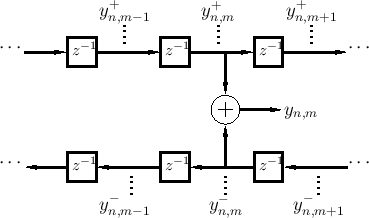
From Eq.(E.6), and referring to the notation defined in
Fig.E.2, we may write the conversion from W to K variables
as


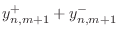

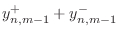

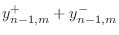
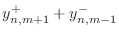
where the last equality follows from the traveling-wave behavior (see Fig.E.2).
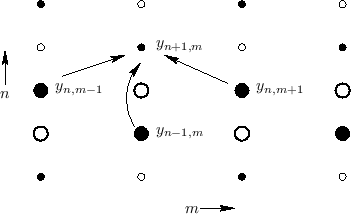
Figure E.3 shows the so-called ``stencil'' of the FDTD scheme.
The larger circles indicate the state at time which can be used to
compute the state at time . The filled and unfilled circles
indicate membership in one of two interleaved grids [55]. To
see why there are two interleaved grids, note that when is even,
the update for  depends only on odd from time and even
from time . Since the two W components of
depends only on odd from time and even
from time . Since the two W components of  are converted to
two W components at time in Eq.(E.8), we have that the update for
depends only on W components from time and positions
are converted to
two W components at time in Eq.(E.8), we have that the update for
depends only on W components from time and positions
 .
Moving to the next position update, for
.
Moving to the next position update, for
 , the state used is
independent of that used for , and the W components used are
from positions and
, the state used is
independent of that used for , and the W components used are
from positions and  . As a result of these observations, we
see that we may write the state-variable transformation separately for
even and odd , e.g.,
. As a result of these observations, we
see that we may write the state-variable transformation separately for
even and odd , e.g.,
![$\displaystyle \left[\! \begin{array}{c} \vdots \\ y_{n,m-1}\\ y_{n-1,m}\\ y_{n,...
...n,m+3}\\ y^{+}_{n,m+5}\\ y^{-}_{n,m+5}\\ \vdots \end{array} \!\right]. \protect$](http://www.dsprelated.com/josimages_new/pasp/img4535.png)
Denote the linear transformation operator by
 and the K and W state vectors
by
and the K and W state vectors
by
 and
and
 , respectively. Then Eq.(E.9) can be restated as

The operator
can be recognized as the Toeplitz operator
associated with the linear, shift-invariant filter
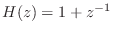 .
While the present context is not a simple convolution since
is
not a simple time series, the inverse of
corresponds to the
Toeplitz operator associated with
.
While the present context is not a simple convolution since
is
not a simple time series, the inverse of
corresponds to the
Toeplitz operator associated with

![$\displaystyle \left[\! \begin{array}{c} \vdots \\ y^{+}_{n,m-1}\\ y^{-}_{n,m-1}...
... y_{n,m+3}\\ y_{n-1,m+4}\\ y_{n,m+5}\\ \vdots \\ \end{array} \!\right] \protect$](http://www.dsprelated.com/josimages_new/pasp/img4542.png)
The case of the finite string is identical to that of the infinite string when the matrix
is simply ``cropped'' to a finite square size
(leaving an isolated 1 in the lower right corner); in such cases,
 as given above is simply cropped to the same size, retaining its
upper triangular
as given above is simply cropped to the same size, retaining its
upper triangular  structure. Another interesting set of cases
is obtained by inserting a 1 in the lower-left corner of the cropped
matrix to make it circulant; in these cases, the
structure. Another interesting set of cases
is obtained by inserting a 1 in the lower-left corner of the cropped
matrix to make it circulant; in these cases, the  matrix
contains
matrix
contains  in every position for even
  , and
is singular for odd (when there is one zero eigenvalue).
, and
is singular for odd (when there is one zero eigenvalue).
Next Section:
Excitation Examples
Previous Section:
Introduction