







Stiff String Synthesis Models
![\includegraphics[width=\twidth]{eps/flstifftstring}](http://www.dsprelated.com/josimages_new/pasp/img1441.png)
An ideal stiff-string synthesis model is drawn in
Fig. 6.13 [10]. See
§C.6 for a detailed derivation. The delay-line length
 is the number of samples in
  periods at frequency
  , where
is the number of the highest partial supported (normally the last
one before
, where
is the number of the highest partial supported (normally the last
one before  ). This is the counterpart of
Fig. 6.12 which depicted ideal-string damping which
was lumped at a single point in the delay-line loop. For the
ideal stiff string, however, (no damping), it is dispersion
filtering that is lumped at a single point of the loop. Dispersion
can be lumped like damping because it, too, is a linear,
time-invariant (LTI) filtering of a propagating wave. Because it is
LTI, dispersion-filtering commutes with other LTI systems in
series, such as delay elements. The allpass filter in
Fig.C.9 corresponds to filter
). This is the counterpart of
Fig. 6.12 which depicted ideal-string damping which
was lumped at a single point in the delay-line loop. For the
ideal stiff string, however, (no damping), it is dispersion
filtering that is lumped at a single point of the loop. Dispersion
can be lumped like damping because it, too, is a linear,
time-invariant (LTI) filtering of a propagating wave. Because it is
LTI, dispersion-filtering commutes with other LTI systems in
series, such as delay elements. The allpass filter in
Fig.C.9 corresponds to filter  in Fig.9.2 for
the Extended Karplus-Strong algorithm. In practice, losses are also
included for realistic string behavior (filter
in Fig.9.2 for
the Extended Karplus-Strong algorithm. In practice, losses are also
included for realistic string behavior (filter  in
Fig.9.2).
in
Fig.9.2).
Allpass filters were introduced in §2.8, and a fairly comprehensive summary is given in Book II of this series [449, Appendix C].7.8The general transfer function for an allpass filter is given (in the real, single-input, single-output case) by
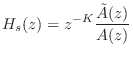
 is an integer pure-delay in samples (all delay lines
are allpass filters),
is an integer pure-delay in samples (all delay lines
are allpass filters),


 as the flip of
  . For example,
if
. For example,
if
 , we have
 . Thus,
is obtained from by simply reversing the order of the
coefficients (and conjugating them if they are complex, but normally
they are real in practice). For an allpass filter simulating
stiffness, we would normally have
. Thus,
is obtained from by simply reversing the order of the
coefficients (and conjugating them if they are complex, but normally
they are real in practice). For an allpass filter simulating
stiffness, we would normally have  , since the filter is already in
series with a delay line.
, since the filter is already in
series with a delay line.
Section 6.11 below discusses some
methods for designing stiffness allpass filters from
measurements of stiff vibrating strings, and
§9.4.1 gives further details for the case of piano
string modeling.
Next Section:
Equivalent Forms
Previous Section:
Terminated String Impedance












