Summary of Wave Digital Elements
From Eq. (F.1), we have that the general reflectance of impedance
 with respect to the reference impedance
  in the wave
variable formulation is given by
in the wave
variable formulation is given by
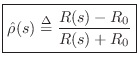
In WDF construction, the free constant in the bilinear transform is taken to be
 . Thus we obtain
![$ \hat{\rho}_d(z) = \hat{\rho}[(1-z^{-1})/(1+z^{-1})]$](http://www.dsprelated.com/josimages_new/pasp/img4796.png) . When
is first order, it is possible to choose the reference
impedance so as to eliminate the delay-free path in the digital
reflectance
. When
is first order, it is possible to choose the reference
impedance so as to eliminate the delay-free path in the digital
reflectance
 , and so its value depends on the actual
physical element being digitized.
, and so its value depends on the actual
physical element being digitized.
Next Section:
Wave Digital Mass
Previous Section:
A Physical Derivation of Wave Digital Elements