Sign in

username:

password:


Not a member?

Search Online Books


Search tips

Free Online Books

Chapters

Chapter Contents:

Search Physical Audio Signal Processing


Book Index | Global Index


Would you like to be notified by email when Julius Orion Smith III publishes a new entry into his blog?


Tonal Correction Filter

Let $ h_k(n)$ denote the component of the impulse response arising from the $ k$th pole of the system. Then the energy associated with that pole is
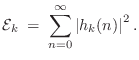
$\displaystyle {\cal E}_k = \sum_{n=0}^\infty \left\vert h_k(n)\right\vert^2
$

All other factors being equal, if the decay time of the mode is shortened by half, it follows that the total energy contributed by that mode to the impulse response is also reduced by half. To compensate for this effect, Jot introduced a tonal correction filter $ E(z)$ to be placed in series with the FDN, as shown in Fig.2.8.

In the case of the first-order delay-line filters discussed in §2.7.5, good tonal correction is given by the following one-zero filter:

$\displaystyle E(z) = \frac{ 1 - bz^{-1}}{1-b}
$

where

$\displaystyle b = \frac{1-\alpha}{1+\alpha}
$

and $ \alpha$ is defined in Eq.$ \,$(2.6).


Order a Hardcopy of Physical Audio Signal Processing

Previous: First-Order Delay-Filter Design
Next: FDNs as Digital Waveguide Networks

written by Julius Orion Smith III
Julius Smith's background is in electrical engineering (BS Rice 1975, PhD Stanford 1983). He is presently Professor of Music and Associate Professor (by courtesy) of Electrical Engineering at Stanford's Center for Computer Research in Music and Acoustics (CCRMA), teaching courses and pursuing research related to signal processing applied to music and audio systems. See http://ccrma.stanford.edu/~jos/ for details.


Comments


No comments yet for this page


Add a Comment
You need to login before you can post a comment (best way to prevent spam). ( Not a member? )