The Tonehole as a Two-Port Loaded Junction
It seems reasonable to expect that the tonehole should be
representable as a load along a waveguide bore model, thus
creating a loaded two-port junction with two identical bore ports on
either side of the tonehole. From the relations for the loaded
parallel junction (C.101), in the two-port case
with
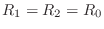 , and considering pressure waves rather than force
waves, we have
, and considering pressure waves rather than force
waves, we have
 |
 |
![$\displaystyle \alpha P_1^{+}+ \alpha P_2^{+}, \quad \alpha = 2\Gamma _0/[G_J(s)+2\Gamma _0]$](http://www.dsprelated.com/josimages_new/pasp/img2526.png) |
(10.63) |
 |
|
 |
(10.64) |
 |
|
 |
(10.65) |
Thus, the loaded two-port junction can be implemented in ``one-filter form'' as shown in Fig. 9.48 with
 (
(
 ) and
) and

 ), is
equivalent to a loaded two-port waveguide junction with
), is
equivalent to a loaded two-port waveguide junction with  ,
i.e., the parallel load impedance is simply the shunt impedance in the
tonehole model.
,
i.e., the parallel load impedance is simply the shunt impedance in the
tonehole model.
Each series impedance  in the split-T model of
Fig. 9.43 can be modeled as a series waveguide
junction with a load of . To see this, set the transmission
matrix parameters in (9.55) to the values
in the split-T model of
Fig. 9.43 can be modeled as a series waveguide
junction with a load of . To see this, set the transmission
matrix parameters in (9.55) to the values
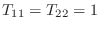 ,
,
 , and
, and  from (9.51) to get
 |
|
 |
|
 |
|
 |
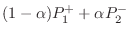
(10.66) |
where
 is the alpha parameter for a series
loaded waveguide junction involving two impedance
is the alpha parameter for a series
loaded waveguide junction involving two impedance  waveguides joined
in series with each other and with a load impedance of , as
can be seen from (C.99). To obtain exactly the loaded series
scattering relations (C.100), we first switch to the more general
convention in which the ``
waveguides joined
in series with each other and with a load impedance of , as
can be seen from (C.99). To obtain exactly the loaded series
scattering relations (C.100), we first switch to the more general
convention in which the `` '' superscript denotes waves traveling into a junction of any number of waveguides. This exchanges ``'' with ``
 ''
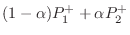
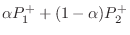
at port 2 to yield
''
at port 2 to yield
|
|
 |
|
 |
|
 |
(10.67) |
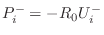
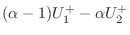
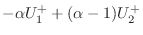
Next we convert pressure to velocity using
 and
and
 to obtain
 |
|
 |
|
 |
|
 |
(10.68) |
Finally, we toggle the reference direction of port 2 (the ``current'' arrow for
 on port 2 in Fig. 9.43) so that velocity is
positive flowing into the junction on both ports (which is the
convention used to derive (C.100) and which is typically followed
in circuit theory). This amounts to negating
on port 2 in Fig. 9.43) so that velocity is
positive flowing into the junction on both ports (which is the
convention used to derive (C.100) and which is typically followed
in circuit theory). This amounts to negating  , giving
|
|
 |
|
|
|
 |
(10.69) |
where
 .
This is then the canonical form (C.100).
.
This is then the canonical form (C.100).
Next Section:
Bowing as Periodic Plucking
Previous Section:
Tonehole Filter Design