Total Energy in a Rigidly Terminated String
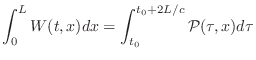
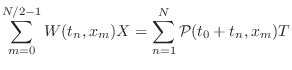
The total energy  in a length
  , rigidly terminated, freely
vibrating string can be computed as
, rigidly terminated, freely
vibrating string can be computed as
 |
 |
 |
(C.54) |
 |
 |
(C.55) |
for any
![$ x\in[0,L]$](http://www.dsprelated.com/josimages_new/pasp/img3519.png) . Since the energy never decays,
. Since the energy never decays,  and
and  are
also arbitrary. Thus, because free vibrations of a doubly terminated
string must be periodic in time, the total energy equals the
integral of power over any period at any point along the string.
are
also arbitrary. Thus, because free vibrations of a doubly terminated
string must be periodic in time, the total energy equals the
integral of power over any period at any point along the string.
Next Section:
Plane-Wave Scattering
Previous Section:
Root-Power Waves