Trapezoidal Rule
The trapezoidal rule is defined by
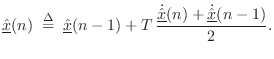
Thus, the trapezoidal rule is driven by the average of the derivative estimates at times
 and
and  . The method is
implicit in either forward or reverse time.
. The method is
implicit in either forward or reverse time.
The trapezoidal rule gets its name from the fact that it approximates
an integral by summing the areas of trapezoids. This can be seen by writing
Eq. (7.12) as
![$\displaystyle \underline{\hat{x}}(n) = \underline{\hat{x}}(n-1) + T\,\dot{\unde...
... T\,\left[\dot{\underline{\hat{x}}}(n) - \dot{\underline{\hat{x}}}(n-1)\right]
$](http://www.dsprelated.com/josimages_new/pasp/img1704.png)
 versus , and connect the samples
with linear segments to form a sequence of trapezoids whose areas must
be summed to yield an approximation to
versus , and connect the samples
with linear segments to form a sequence of trapezoids whose areas must
be summed to yield an approximation to
 . Then the integral
at time ,
, is given by the integral at time ,
. Then the integral
at time ,
, is given by the integral at time ,
 , plus the area of the next rectangle,
 , plus the area of the new triangular piece atop
the new rectangle,
, plus the area of the new triangular piece atop
the new rectangle,
![$ T\,[\dot{\underline{\hat{x}}}(n) - \dot{\underline{\hat{x}}}(n-1)]/2$](http://www.dsprelated.com/josimages_new/pasp/img1708.png) . In
other words, the integral at time equals the integral at time
plus the area of the next trapezoid in the sum.
. In
other words, the integral at time equals the integral at time
plus the area of the next trapezoid in the sum.
An interesting fact about the trapezoidal rule is that it is
equivalent to the bilinear transform in the linear,
time-invariant case. Carrying Eq.(7.12) to the frequency domain
gives
![\begin{eqnarray*}
X(z) &=& z^{-1}X(z) + T\, \frac{s X(z) + z^{-1}s X(z)]}{2}\\
...
...gleftrightarrow\quad s &=& \frac{2}{T}\frac{1-z^{-1}}{1+z^{-1}}.
\end{eqnarray*}](http://www.dsprelated.com/josimages_new/pasp/img1709.png)
Next Section:
Newton's Method of Nonlinear Minimization
Previous Section:
Backward Euler Method