Traveling-Wave Solution
It is easily shown that the lossless 1D wave equation
 is solved by any string shape which travels to the left or right with
speed
is solved by any string shape which travels to the left or right with
speed
 . Denote right-going
traveling waves in general by
. Denote right-going
traveling waves in general by
 and left-going
traveling waves by
and left-going
traveling waves by
 , where
  and
and  are assumed
twice-differentiable.C.1Then a general class of solutions to the
lossless, one-dimensional, second-order wave equation can be expressed
as
are assumed
twice-differentiable.C.1Then a general class of solutions to the
lossless, one-dimensional, second-order wave equation can be expressed
as
The next section derives the result that
 and
and
 , establishing that the wave equation is satisfied for all
traveling wave shapes and . However, remember that the
derivation of the wave equation in §B.6 assumes the
string slope is much less than
, establishing that the wave equation is satisfied for all
traveling wave shapes and . However, remember that the
derivation of the wave equation in §B.6 assumes the
string slope is much less than  at all times and positions.
Finally, we show in §C.3.6 that the traveling-wave picture is
general; that is, any physical state of the string can be
converted to a pair of equivalent traveling force- or velocity-wave
components.
at all times and positions.
Finally, we show in §C.3.6 that the traveling-wave picture is
general; that is, any physical state of the string can be
converted to a pair of equivalent traveling force- or velocity-wave
components.
An important point to note about the traveling-wave solution of the 1D
wave equation is that a function of two variables  has been
replaced by two functions of a single variable in time units. This
leads to great reductions in computational complexity.
has been
replaced by two functions of a single variable in time units. This
leads to great reductions in computational complexity.
The traveling-wave solution of the wave equation was first published by d'Alembert in 1747 [100]. See Appendix A for more on the history of the wave equation and related topics.
Traveling-Wave Partial Derivatives
Because we have defined our traveling-wave components
and
as having arguments in units of time, the partial
derivatives with respect to time  are identical to simple
derivatives of these functions. Let
are identical to simple
derivatives of these functions. Let
 and
and
 denote the
(partial) derivatives with respect to time of and ,
respectively. In contrast, the partial derivatives with respect to
denote the
(partial) derivatives with respect to time of and ,
respectively. In contrast, the partial derivatives with respect to  are
are
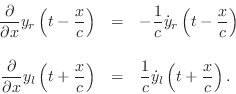
Denoting the spatial
partial derivatives by  and
and
 , respectively, we can write more succinctly
![\begin{eqnarray*}
y'_r&=& -\frac{1}{c}{\dot y}_r\\ [5pt]
y'_l&=& \frac{1}{c}{\dot y}_l,
\end{eqnarray*}](http://www.dsprelated.com/josimages_new/pasp/img3234.png)
where this argument-free notation assumes the same and for all
terms in each equation, and the subscript  or
or  determines
whether the omitted argument is
determines
whether the omitted argument is  or
or  .
.
Now we can see that the second partial derivatives in are

These relations, together with the fact that partial differention is a linear operator, establish that

 for all
twice-differentiable functions and .
for all
twice-differentiable functions and .
Use of the Chain Rule
These traveling-wave partial-derivative relations may be derived a bit
more formally by means of the chain rule from calculus, which
states that, for the composition of functions  and
and  , i.e.,
 can be expressed
according to the chain rule as
can be expressed
according to the chain rule as
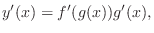
 denotes the derivative of
  with respect to
.
with respect to
.
To apply the chain rule to the spatial differentiation of traveling waves, define
![\begin{eqnarray*}
g_r(t,x) &=& t - \frac{x}{c}\\ [10pt]
g_l(t,x) &=& t + \frac{x}{c}.
\end{eqnarray*}](http://www.dsprelated.com/josimages_new/pasp/img3242.png)
Then the traveling-wave components can be written as
![$ y_r[g_r(t,x)]$](http://www.dsprelated.com/josimages_new/pasp/img3243.png) and
and
![$ y_l[g_l(t,x)]$](http://www.dsprelated.com/josimages_new/pasp/img3244.png) , and their partial derivatives with respect to
become
, and their partial derivatives with respect to
become
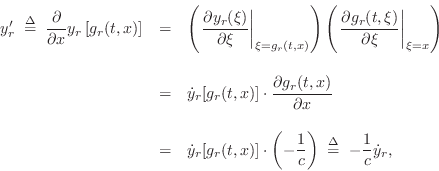
and similarly for .
String Slope from Velocity Waves
Let's use the above result to derive the slope of the ideal
vibrating string
From Eq. (C.11), we have the string displacement given by


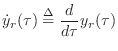
 .
By the chain rule,
.
By the chain rule,

 .
Thus, the string slope in terms of traveling velocity-wave components can be written as
.
Thus, the string slope in terms of traveling velocity-wave components can be written as

Wave Velocity
Because  is an eigenfunction under differentiation
(i.e., the exponential function is its own derivative), it is often
profitable to replace it with a generalized exponential function, with
maximum degrees of freedom in its parametrization, to see if
parameters can be found to fulfill the constraints imposed by differential
equations.
is an eigenfunction under differentiation
(i.e., the exponential function is its own derivative), it is often
profitable to replace it with a generalized exponential function, with
maximum degrees of freedom in its parametrization, to see if
parameters can be found to fulfill the constraints imposed by differential
equations.
In the case of the one-dimensional ideal wave equation (Eq.(C.1)),
with no boundary conditions, an appropriate choice of eigensolution is
 |
(C.12) |
Substituting into the wave equation yields
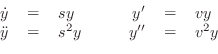
 , the wave equation becomes
 |
 |
 |
(C.13) |
 |
|
 |
|
 |
|
 |
Thus
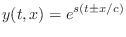
 . By superposition,

 and
and
 are arbitrary
complex-valued functions of arbitrary points
are arbitrary
complex-valued functions of arbitrary points  in the complex plane.
D'Alembert Derived
Setting
 , and extending the summation to an integral,
we have, by Fourier's theorem,
, and extending the summation to an integral,
we have, by Fourier's theorem,

for arbitrary continuous functions
 and
and
 . This is again the traveling-wave solution of the wave
equation attributed to d'Alembert, but now derived from the
eigen-property of sinusoids and Fourier theory rather than
``guessed''.
. This is again the traveling-wave solution of the wave
equation attributed to d'Alembert, but now derived from the
eigen-property of sinusoids and Fourier theory rather than
``guessed''.
An example of the appearance of the traveling wave components shortly after plucking an infinitely long string at three points is shown in Fig.C.2.
![\includegraphics[width=\twidth]{eps/f_t_waves_no_term}](http://www.dsprelated.com/josimages_new/pasp/img3269.png) |
 shortly after time 0, the traveling waves centers are
separated by
shortly after time 0, the traveling waves centers are
separated by 
 .
.
Converting Any String State to Traveling Slope-Wave Components
We verified in §C.3.1 above that traveling-wave components
and in Eq.(C.14) satisfy the ideal string wave equation
. By definition, the physical string displacement is
given by the sum of the traveling-wave components, or

Thus, given any pair of traveling waves
and , we can
compute a corresponding string displacement  . This leads to the
question whether any initial string state can be converted to a pair
of equivalent traveling-wave components. If so, then d'Alembert's
traveling-wave solution is complete, and all solutions to the
ideal string wave equation can be expressed in terms of traveling waves.
. This leads to the
question whether any initial string state can be converted to a pair
of equivalent traveling-wave components. If so, then d'Alembert's
traveling-wave solution is complete, and all solutions to the
ideal string wave equation can be expressed in terms of traveling waves.
The state of an ideal string at
time is classically specified by its displacement and
velocity
 [317]. Equation (C.15) gives us as a simple sum of
the traveling-wave components, and now we need a formula for
[317]. Equation (C.15) gives us as a simple sum of
the traveling-wave components, and now we need a formula for  in
terms of them as well. It will be derived in §C.7.3
(see Equations (C.44-C.46)) that we can write
in
terms of them as well. It will be derived in §C.7.3
(see Equations (C.44-C.46)) that we can write

 denotes the partial derivative with respect to as
usual. We have
denotes the partial derivative with respect to as
usual. We have
![$\displaystyle \left[\begin{array}{c} y(t,x) \\ [2pt] v(t,x) \end{array}\right] ...
...ght]
\left[\begin{array}{c} y_r(t-x/c) \\ [2pt] y_l(t+x/c) \end{array}\right].
$](http://www.dsprelated.com/josimages_new/pasp/img3273.png)
![$\displaystyle \left[\begin{array}{c} y'^{+} \\ [2pt] y'^{-} \end{array}\right] ...
...eft[\begin{array}{c} y'-\frac{v}{c} \\ [2pt] y'+\frac{v}{c} \end{array}\right]
$](http://www.dsprelated.com/josimages_new/pasp/img3274.png) , and choosing the constant
of integration to give the correct constant component of , we
obtain the displacement-wave components
, and choosing the constant
of integration to give the correct constant component of , we
obtain the displacement-wave components
![$\displaystyle \left[\begin{array}{c} y^{+} \\ [2pt] y^{-} \end{array}\right] \eqsp \frac{1}{2}\left[\begin{array}{c} y-w \\ [2pt] y+w \end{array}\right]
$](http://www.dsprelated.com/josimages_new/pasp/img3275.png)
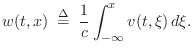
It will be seen in §C.7.4 that state conversion between physical variables and traveling-wave components is simpler when force and velocity are chosen as the physical state variables (as opposed to displacement and velocity used here).
Next Section:
Sampled Traveling Waves
Previous Section:
The Finite Difference Approximation