Use of the Chain Rule
These traveling-wave partial-derivative relations may be derived a bit
more formally by means of the chain rule from calculus, which
states that, for the composition of functions  and
and  , i.e.,

 can be expressed
according to the chain rule as
can be expressed
according to the chain rule as
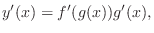
 denotes the derivative of
  with respect to
.
with respect to
.
To apply the chain rule to the spatial differentiation of traveling waves, define
![\begin{eqnarray*}
g_r(t,x) &=& t - \frac{x}{c}\\ [10pt]
g_l(t,x) &=& t + \frac{x}{c}.
\end{eqnarray*}](http://www.dsprelated.com/josimages_new/pasp/img3242.png)
Then the traveling-wave components can be written as
![$ y_r[g_r(t,x)]$](http://www.dsprelated.com/josimages_new/pasp/img3243.png) and
and
![$ y_l[g_l(t,x)]$](http://www.dsprelated.com/josimages_new/pasp/img3244.png) , and their partial derivatives with respect to
become
, and their partial derivatives with respect to
become
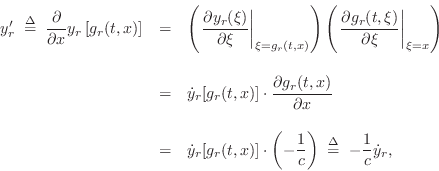
and similarly for  .
.
Next Section:
String Slope from Velocity Waves
Previous Section:
Traveling-Wave Partial Derivatives