







Vector Formulation
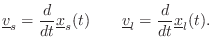
Denote the sound-source velocity by
 where
where
 is time. Similarly,
let
is time. Similarly,
let
 denote the velocity of the listener, if any. The
position of source and listener are denoted
denote the velocity of the listener, if any. The
position of source and listener are denoted
 and
and
 , respectively, where
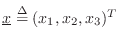 is 3D
position. We have velocity related to position by
is 3D
position. We have velocity related to position by
Consider a Fourier component of the source at frequency
 . We
wish to know how this frequency is shifted to
. We
wish to know how this frequency is shifted to  at the listener
due to the Doppler effect.
at the listener
due to the Doppler effect.
The Doppler effect depends only on velocity components along the line
connecting the source and listener [349, p. 453]. We may
therefore orthogonally project the source and listener
velocities onto the vector
 pointing from the source
to the listener. (See Fig.5.8 for a specific example.)
pointing from the source
to the listener. (See Fig.5.8 for a specific example.)
The orthogonal projection of a vector
 onto a vector
 is given by [451]


In the far field (listener far away), Eq.
 (5.4) reduces to

Next Section:
Doppler Simulation via Delay Lines
Previous Section:
Summary of Flanging












