Volume Velocity of a Gas
The volume velocity  of a gas flow is defined as particle
velocity
of a gas flow is defined as particle
velocity  times the cross-sectional area
  of the flow, or
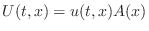
 denotes position along the flow, and
  denotes time in
seconds. Volume velocity is thus in physical units of volume per
second (m
denotes time in
seconds. Volume velocity is thus in physical units of volume per
second (m /s).
/s).
When a flow is confined within an enclosed channel, as it is in an
acoustic tube, volume velocity is conserved when the tube
changes cross-sectional area, assuming the density  remains
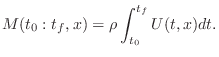
constant. This follows directly from conservation of mass in a flow:
The total mass passing a given point along the flow is given by
the mass density times the integral of the volume volume
velocity at that point, or
remains
constant. This follows directly from conservation of mass in a flow:
The total mass passing a given point along the flow is given by
the mass density times the integral of the volume volume
velocity at that point, or
As a simple example, consider a constant flow through two cylindrical
acoustic tube sections having cross-sectional areas  and
and  ,
respectively. If the particle velocity in cylinder 1 is
,
respectively. If the particle velocity in cylinder 1 is  , then
the particle velocity in cylinder 2 may be found by solving
, then
the particle velocity in cylinder 2 may be found by solving

 .
.
It is common in the field of acoustics to denote volume velocity by an
upper-case . Thus, for the two-cylinder acoustic tube example above,
we would define
 and
and
 , so that

Next Section:
Pressure is Confined Kinetic Energy
Previous Section:
Particle Velocity of a Gas