Wave Velocity
Because  is an eigenfunction under differentiation
(i.e., the exponential function is its own derivative), it is often
profitable to replace it with a generalized exponential function, with
maximum degrees of freedom in its parametrization, to see if
parameters can be found to fulfill the constraints imposed by differential
equations.
is an eigenfunction under differentiation
(i.e., the exponential function is its own derivative), it is often
profitable to replace it with a generalized exponential function, with
maximum degrees of freedom in its parametrization, to see if
parameters can be found to fulfill the constraints imposed by differential
equations.
In the case of the one-dimensional ideal wave equation (Eq. (C.1)),
with no boundary conditions, an appropriate choice of eigensolution is
(C.1)),
with no boundary conditions, an appropriate choice of eigensolution is
 |
(C.12) |
Substituting into the wave equation yields
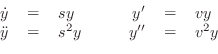
 , the wave equation becomes
 |
 |
 |
(C.13) |
 |
|
 |
|
 |
|
 |
Thus
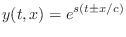
 . By superposition,

 and
and
 are arbitrary
complex-valued functions of arbitrary points
are arbitrary
complex-valued functions of arbitrary points  in the complex plane.
Next Section:
D'Alembert Derived
Previous Section:
String Slope from Velocity Waves