Young's Modulus
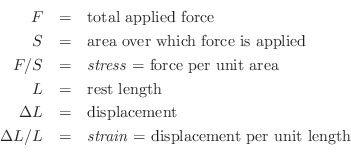
Young's modulus can be thought of as the spring constant
for solids. Consider an ideal rod (or bar) of length  and
cross-sectional area
and
cross-sectional area  . Suppose we apply a force
  to the face of
area , causing a displacement
to the face of
area , causing a displacement  along the axis of the rod.
Then Young's modulus
along the axis of the rod.
Then Young's modulus  is given by

For wood, Young's modulus is on the order of  N/m
N/m .
For aluminum, it is around
.
For aluminum, it is around  (a bit higher than glass which is near
 ), and structural steel has
 [180].
Young's Modulus as a Spring Constant
Recall (§B.1.3) that Hooke's Law defines a spring
constant  as the applied force divided by the spring
displacement
as the applied force divided by the spring
displacement  , or
, or  . An elastic solid can be viewed as a
bundle of ideal springs. Consider, for example, an ideal
bar (a rectangular solid in which one dimension, usually its
longest, is designated its length ), and consider compression by
along the length dimension. The length of each spring in
the bundle is the length of the bar, so that each spring constant
must be inversely proportional to ; in particular, each doubling of
length doubles the length of each ``spring'' in the bundle, and
therefore halves its stiffness. As a result, it is useful to
normalize displacement by length and use relative
displacement
. An elastic solid can be viewed as a
bundle of ideal springs. Consider, for example, an ideal
bar (a rectangular solid in which one dimension, usually its
longest, is designated its length ), and consider compression by
along the length dimension. The length of each spring in
the bundle is the length of the bar, so that each spring constant
must be inversely proportional to ; in particular, each doubling of
length doubles the length of each ``spring'' in the bundle, and
therefore halves its stiffness. As a result, it is useful to
normalize displacement by length and use relative
displacement
 . We need displacement per unit length
because we have a constant spring compliance per unit length.
. We need displacement per unit length
because we have a constant spring compliance per unit length.
The number of springs in parallel is proportional to the
cross-sectional area of the bar. Therefore, the force applied to
each spring is proportional to the total applied force divided by
the cross-sectional area . Thus, Hooke's law for each spring in the
bundle can be written
 is Young's modulus.
We may say that Young's modulus is the Hooke's-law spring constant for the spring made from a specifically cut section of the solid material, cut to length 1 and cross-sectional area 1. The shape of the cross-sectional area does not matter since all displacement is assumed to be longitudinal in this model.
Next Section:
String Tension
Previous Section:
Equations of Motion for Rigid Bodies