







Zita-Rev1 Delay-Line Filters
In zita-rev1, the damping filter for each delay line consists
of a low-shelf filter  [449],4.19in series with a unique first-order lowpass filter
  that sets
the high-frequency
that sets
the high-frequency  to be half that of the middle-band at a
particular frequency
to be half that of the middle-band at a
particular frequency  (specified as ``HF Damping'' in the GUI).
Since the filter
(specified as ``HF Damping'' in the GUI).
Since the filter  is constrained to be a lowpass,
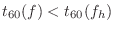 for
for  , i.e., the decay time gets
shorter at higher frequencies.
, i.e., the decay time gets
shorter at higher frequencies.
Viewing the resulting damping filter
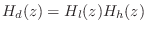 as a
three-band filter bank (§3.7.5), let
as a
three-band filter bank (§3.7.5), let  and
and  denote the
desired band gains at dc and ``middle frequencies'',
respectively.4.20 Then the low shelf may be set for a
desired dc-gain of
denote the
desired band gains at dc and ``middle frequencies'',
respectively.4.20 Then the low shelf may be set for a
desired dc-gain of  , and its input (or output) signal
multiplied by to obtain the resulting filter
, and its input (or output) signal
multiplied by to obtain the resulting filter

 denotes the (real) first-order lowpass pole, given by
[449]
denotes the (real) first-order lowpass pole, given by
[449]
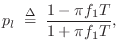
 specifies (in Hz) the crossover point between ``low'' and
``middle'' frequencies, and
specifies (in Hz) the crossover point between ``low'' and
``middle'' frequencies, and  denotes the sampling interval as
usual.
denotes the sampling interval as
usual.
The lowpass filter is also first order, and to provide half
the middle-band at the beginning of the ``high'' band, the
lowpass should ``break'' to a gain of at the ``HF Damping''
frequency specified in the GUI. A unity-dc-gain one-pole
lowpass has the form [449]
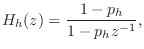
 must be found to give a gain of
  at frequency :

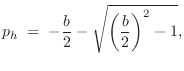
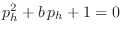 . Solving for using the quadratic formula
yields
. Solving for using the quadratic formula
yields

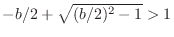 is discarded.
To ensure
is discarded.
To ensure  , the GUI must limit the middle-band to
finite values. (The upper limit is presently
, the GUI must limit the middle-band to
finite values. (The upper limit is presently  seconds for both low
and middle frequencies.)
seconds for both low
and middle frequencies.)
Next Section:
Spatialization of Reverberant Reflections
Previous Section:
Multiband Delay-Filter Design












