``Piano hammer in flight''
Suppose we wish to model a situation in which a mass of size  kilograms is traveling with a constant velocity. This is an
appropriate model for a piano hammer after its key has been pressed
and before the hammer has reached the string.
kilograms is traveling with a constant velocity. This is an
appropriate model for a piano hammer after its key has been pressed
and before the hammer has reached the string.
Figure F.2 shows the ``wave digital mass'' derived previously.
The derivation consisted of inserting an infinitesimal
waveguideF.3 having (real) impedance
, solving for the force-wave reflectance of the mass as seen from
the waveguide, and then mapping it to the discrete time domain using
the bilinear transform.
We now need to attach the other end of the transmission line to a ``force source'' which applies a force of zero newtons to the mass. In other words, we need to terminate the line in a way that corresponds to zero force.
Let the force-wave components entering and leaving the mass
be denoted  and
and  , respectively (i.e., we are dropping
the subscript `d' in Fig.F.2).
The physical force associated with the mass is
, respectively (i.e., we are dropping
the subscript `d' in Fig.F.2).
The physical force associated with the mass is

 . This is illustrated in Fig.F.8.

Figure F.8a (left portion) illustrates what we derived
by physical reasoning, and as such, it is most appropriate as a
physical model of the constant-velocity mass. However, for actual
implementation, Fig.F.8b would be more typical in
practice. This is because we can always negate the state variable
 if needed to convert it from
 to
to
 . It is
very common to see final simplifications like this to maximize
efficiency.
. It is
very common to see final simplifications like this to maximize
efficiency.
Note that Fig.F.8b can be interpreted physically as a wave
digital spring displaced by a constant force
 .
.
Extracting Physical Quantities
Since we are using a force-wave simulation, the state variable
(delay element output) is in units of physical force (newtons).
Specifically,
 . (The physical force is, of
course, 0, while its traveling-wave components are not 0 unless the
mass is at rest.) Using the fundamental relations relating traveling
force and velocity waves
. (The physical force is, of
course, 0, while its traveling-wave components are not 0 unless the
mass is at rest.) Using the fundamental relations relating traveling
force and velocity waves
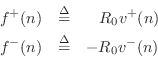
where  here, it is easy to convert the state variable to
other physical units, as we now demonstrate.
here, it is easy to convert the state variable to
other physical units, as we now demonstrate.
The velocity of the mass, for example, is given by
 can be scaled by
  to ``read out''
the mass velocity.
to ``read out''
the mass velocity.
The kinetic energy of the mass is given by
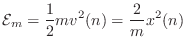 can be scaled by
to produce the physical kinetic energy associated with the mass.
can be scaled by
to produce the physical kinetic energy associated with the mass.
Next Section:
Force Driving a Mass
Previous Section:
General Series Adaptor for Force Waves